
Rule of law fuels American dream, Law Day reminds us
In this Shore Story, Kevin J. Bowling explains how the legal system protects rights, builds trust, and sustains opportunity and fairness across communities and institutions nationwide.

Kevin J. Bowling speaks April 30 at the Ottawa County Bar Association’s Law Day Dinner.
This is part of the Shore Stories: Life Along the Lakeshore series, which includes columns by local and former residents about how people are making a difference along the Lakeshore.
Next month, communities across the country will mark Law Day — a national observance established in 1958 by Dwight D. Eisenhower to highlight the role of the legal system in preserving democracy, order, and justice in the United States.
Observed each year on May 1, Law Day encourages Americans to better understand how laws function, recognize their rights and liberties, and appreciate the rule of law as a cornerstone of a free society. While the date coincides with International Workers’ Day, its focus is not labor movements, but the principles that make freedom and opportunity possible.
This year’s theme — “The Rule of Law and the American Dream” — raises a simple but essential question: What makes opportunity real in America?
The answer is not abstract. It is practical, visible, and present in everyday life — in courtrooms, clerk’s offices, and communities across Michigan and the nation.
The rule of law is what turns aspiration into opportunity.
It allows entrepreneurs to start businesses with confidence that contracts will be enforced. It gives families a structured way to resolve disputes peacefully. It ensures that people who enter a courthouse are heard — not because of status or influence, but because the system is designed to treat them fairly.
Basic principles
At its core, the rule of law rests on three principles: No one is above the law, no one is beneath its protection, and decisions are made based on standards — not politics, pressure, or volume.
That promise underpins the American Dream.
But the rule of law does not live solely in statutes or court opinions. It is experienced in human interactions: when a judge explains a decision clearly, when a lawyer respects the process, or when a court employee helps someone understand what comes next.
These moments may seem routine, but they build trust — and trust is the currency of the rule of law.
Without it, even the strongest legal systems weaken.
Today, that trust faces new challenges. Rapid technological change, constant connectivity, and the speed of information have blurred the line between fact and perception. Social media often rewards reaction over reflection. Artificial intelligence can prioritize speed over judgment.
In this environment, the rule of law becomes even more critical. It slows decision-making. It demands evidence. It emphasizes process over impulse. It reinforces the idea that justice is not a reaction, but a responsibility.
Democracy depends on that discipline.
Without the rule of law, rights can feel uncertain and fairness can appear inconsistent. When fairness is questioned, trust erodes.
The rule of law draws a clear line between majority rule and mob rule. It ensures that power alone does not define justice.
That is why courts matter.
Vital role of courts
Courts are not just places where cases are decided. They are where people determine whether the system can be trusted. For many, a single interaction with a judge, clerk, or attorney shapes their perception of justice.
And what people remember most is not always the outcome — it is how they were treated.
Were they heard?
Were they respected?
Were they given a fair opportunity?
Those experiences determine whether justice feels real.
The rule of law, however, is not self-sustaining. It depends on human choices.
It weakens when laws are applied unevenly.
It weakens when truth is disregarded.
It weakens when cynicism replaces trust.
And once trust is lost, rebuilding it is difficult.
Responsibility for upholding the rule of law belongs to everyone.
For legal professionals, it means making fairness visible in every interaction. For citizens, it means respecting the law not only out of obligation, but belief in its purpose. For communities, it means defending principles even when it is uncomfortable.
Preserving the rule of law
The rule of law is sustained not just by enforcement, but by culture — by habits of honesty, civility, and respect.
There are practical steps forward.
Stay alert. In a fast-moving world, discernment cannot be outsourced.
Stay civil. Disagreement should not come at the expense of shared humanity.
Stay open. Access to justice must be meaningful and inclusive.
Ultimately, the rule of law is not just a legal concept. It is a lived experience.
It is the confidence that the system works.
It is the belief that fairness is possible.
It is the understanding that justice belongs to everyone.
That is what keeps the American Dream alive.
Every time fairness is upheld, a process is explained, or dignity is extended, that promise is reinforced — a promise that opportunity in America is not reserved for a few, but protected for all.
Photo courtesy of Kevin J. Bowling
Kevin J. Bowling is chief administrative officer for the International Association for Court Administration. This column is adapted from the speech he will give to the Ottawa County Bar Association Law Day Dinner held April 30.
Related Articles

GVSU Symposium brings national voices together to support Black men and boys
More than 500 people gathered in Battle Creek for GVSU’s Black Men and Boys Symposium, focused on improving educational, health and career outcomes.

West Coast Chamber’s Community Impact Day of volunteer service expands nationwide
Thousands volunteered nationwide during West Coast Chamber’s fifth annual Community Impact Day, strengthening communities through coordinated service and collaboration.
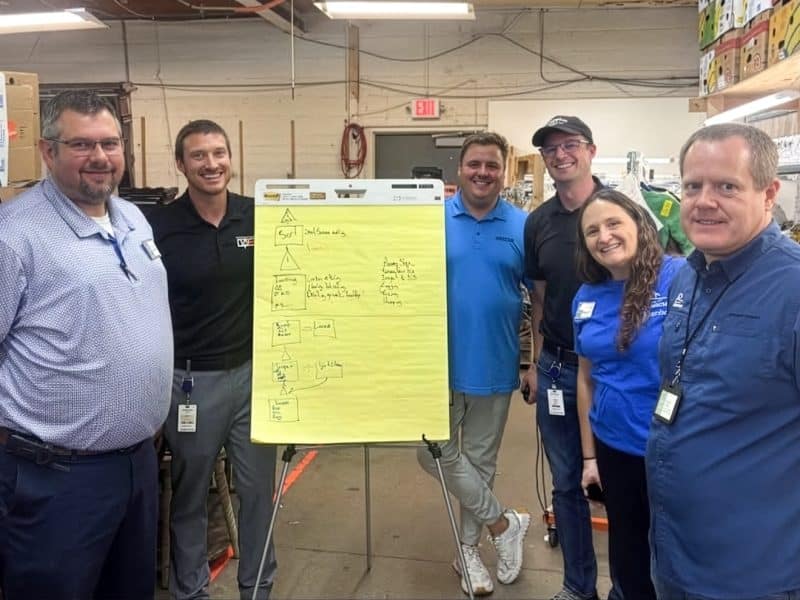
Gentex engineers help nonprofits improve efficiency
Gentex engineers apply manufacturing skills to streamline donations, boost volunteer impact, and expand services at Community Action House and Kids’ Food Basket.