Gentex engineers help nonprofits improve efficiency
Gentex engineers apply manufacturing skills to streamline donations, boost volunteer impact, and expand services at Community Action House and Kids’ Food Basket.
The recent opening of a second resale store by Community Action House marks a major expansion of its work serving local families.
Shoppers enjoying the recently opened second resale store by Community Action House readily recognize the benefits of the new space. Less obvious is a behind-the-scenes effort that makes the operation more efficient and enhances the organization’s impact.
The Northside Resale Store, 650 Riley St. in Holland, doubles the nonprofit’s retail footprint, expanding access to affordable goods while generating revenue to support food access, housing connections, and other services.
“This new store means we can do twice as much good together,” says Scott Rumpsa, CEO of Community Action House. “When someone donates or shops resale, it turns into something much bigger — groceries on a neighbor’s table, clothes for a child starting school, or furniture for a family moving into their first home.”
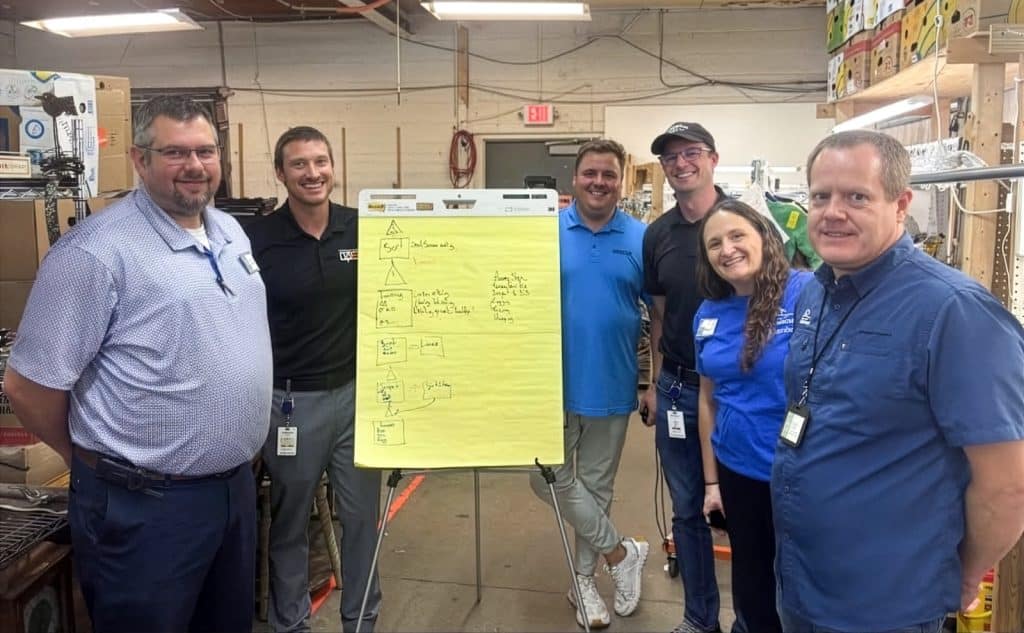
The new store also reflects months of work to improve how donations are processed, with work led in part by a team of engineers from Gentex.
Gentex’s continuous improvement team works across production lines, breaking down complex manufacturing processes so employees can complete tasks more efficiently. While their work typically focuses on high-tech systems, the team applied the same approach to a very different environment.
“It seems like it’s two very different things, but it’s actually pretty similar,” says Steve Burgett, a continuous improvement engineer at Gentex. “Everyone has processes to accomplish certain tasks.”
Making sure the price is right
When Burgett and his colleagues volunteered at the nonprofit’s resale operation, they saw a familiar problem: a process that worked, but not as smoothly as it could.
Shoppers enjoying the recently opened second resale store by Community Action House readily recognize the benefits of the new space. Less obvious is a behind-the-scenes effort that makes the operation more efficient and enhances the organization’s impact.
“Taking the donations in can be a bit erratic,” Burgett says. “Community Action House had benchmarks for how quickly they should be taking donations in and listing them for sale. They were at 60% of that rate.”
Volunteers of all experience levels handled every step, from unloading donations to sorting clothing to determining pricing. That created slowdowns, especially when less-experienced volunteers tackled more complex tasks.
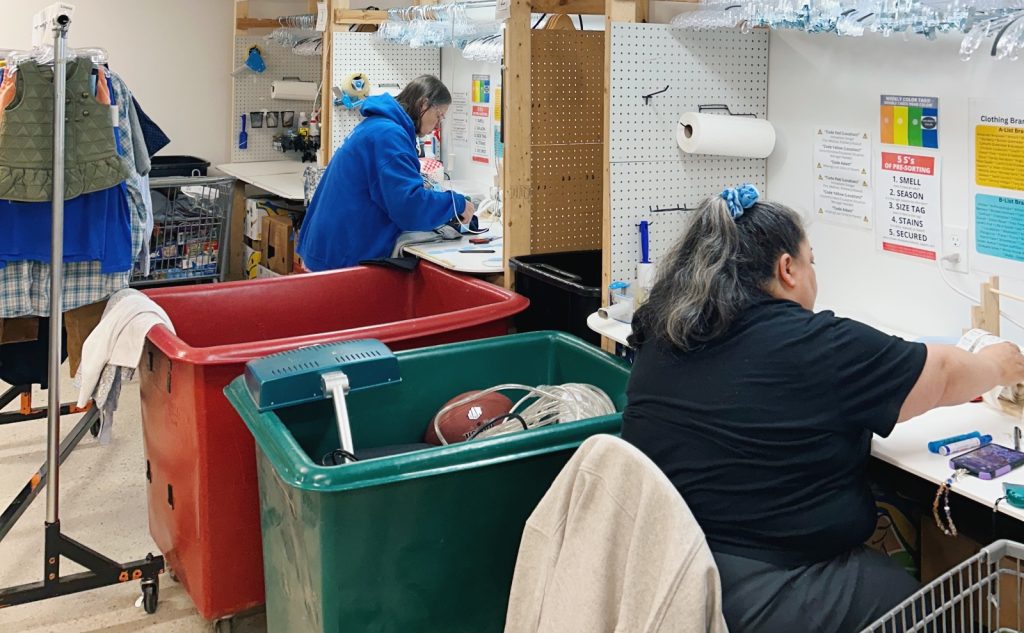
“Knowing how to price an item right is a very difficult task,” Burgett says.
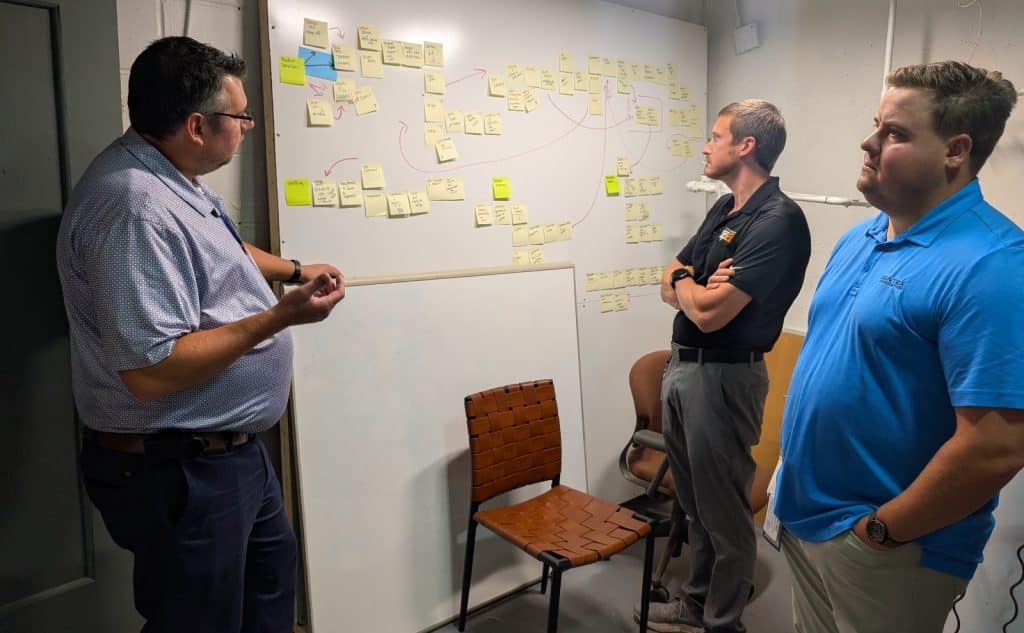
The team mapped out each step of the process, identifying where time and effort were concentrated. They reorganized the workflow, assigning simpler tasks to volunteers and reserving pricing decisions for trained staff.
“It’s kind of who’s doing what, and making sure that no one part of the process has more work than another,” Burgett says.
“You take the load off of that trained associate… and let volunteers do the simpler tasks.”
The changes made a measurable difference.
“They were around 35 units an hour,” Burgett says. After restructuring the workflow, output increased significantly. “They got north of 50 units an hour,” he says.
Lighter load for volunteers
Jordan Kimble, Gentex’s senior continuous improvement manager, says the revised system also made it easier for volunteers to contribute.
“Now, one-time volunteers can perform steps that take five minutes to learn,” Kimble says. “Experienced volunteers or staff use their prior knowledge to quickly price each item to get it to the sales floor.”
The team also worked with Community Action House to test different workspace layouts, reducing how far volunteers had to walk and speeding up the movement of goods from intake to display.
The updated processes were incorporated into the design of the new Northside store, while improvements are also underway at the nonprofit’s original Michigan Avenue location, including a new donation drop-off shelter and refreshed sales floor.
Kimble says the work reflects a broader principle.
“Eighty percent of your cost savings comes from improving the human factors — not automation,” he says. “It’s kind of a misnomer that you need high-tech, expensive automation to improve processes.”
Smoother meal preparation
The team has applied similar ideas at Kids’ Food Basket, which provides evening meals to children across West Michigan.
Around 2020, volunteers from Gentex began working at the organization’s Grand Rapids site, where they noticed inefficiencies in the movement of food from storage to meal assembly stations.
“They were trying to keep tabs on 15 different stations… trying to keep track of who was running low on what,” Kimble says.
The engineers developed a clearer system for delivering supplies and tracking needs.
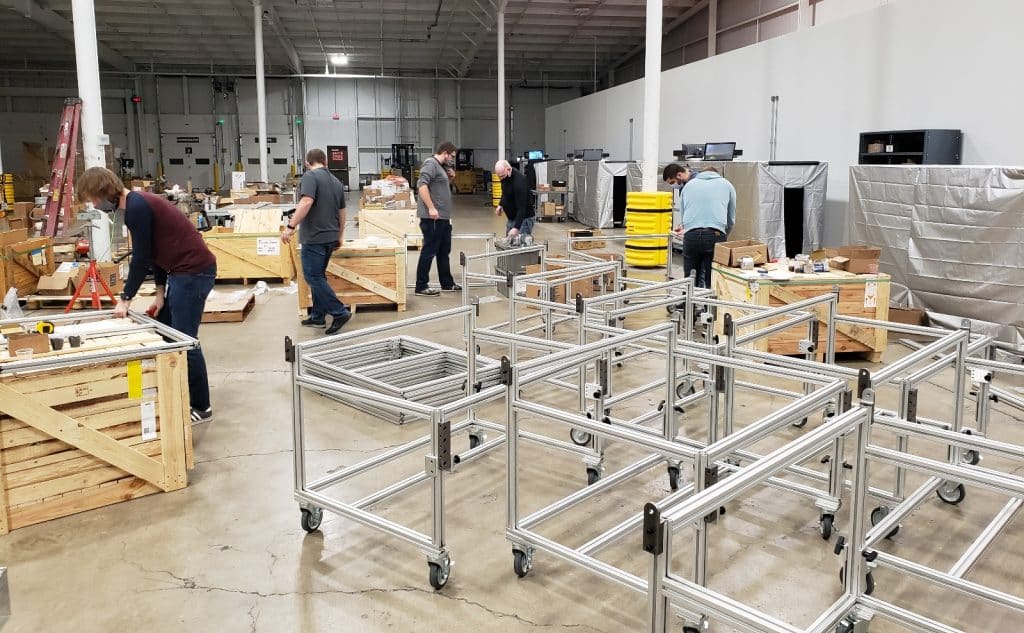
“We were able to establish an efficient way to get materials from the warehouse to the lines,” he says.
At the Holland location, another issue stood out.
“That location only had folding tables to assemble (Sack Suppers),” Kimble says. “You couldn’t move product in and out of the space in a way that was ergonomic — things were sliding all over the place.”
With support from company leadership and internal teams, Gentex designed and built custom workstations for meal preparation. The stations improved stability and workflow.
“They’ve been using those since 2020,” Kimble said. “We’ve been back a couple of times volunteering, and they’re still ecstatic about those tables.”
Austin Roelofs, vice president of food access and agriculture at KFB, credited Gentex’s expertise with streamlining operations.
“We are incredibly grateful to Gentex for their commitment to ensuring thousands of kids receive healthy evening meals,” Roelofs said. “By designing and building more efficient packing tables, their team helped volunteers work faster and more safely, making a tangible difference for children and families in our community.”
Sharing talents
The experience changed how the team approaches volunteer work.
“That kickstarted us finding opportunities where we can use our skills and tools from Gentex and apply them to share with our community partners,” Kimble says.
Volunteers at Kids’ Food Basket noticed the difference.
“It didn’t feel like chaos,” Kimble says. “They felt the workload was less. They’re able to jump right into the process.”
Many nonprofits operate without access to this kind of technical expertise.
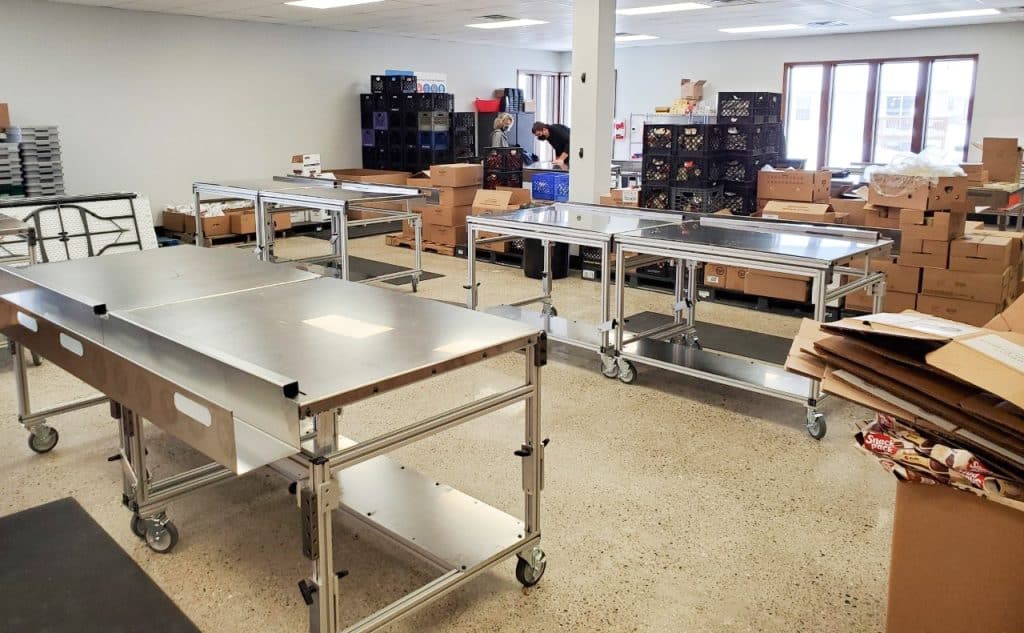
New tables built by Gentex are installed at Kids’ Food Basket.
“A lot of these nonprofits don’t have the budgets to have engineering teams,” Kimble says.
The collaborations allow organizations to expand their reach while leveraging existing resources and volunteer networks.
“You can’t fake it,” Kimble says. “You have to really dive in and understand what’s going on.”
Burgett says the unfamiliar setting adds to the appeal.
“We like solving puzzles,” he says. “The opportunity to go somewhere else and see something completely new and different is really exciting.”
The approach made a difference for Community Action House, says James Smead, the nonprofit’s director of resale operations.
“As we prepared to open our second Resale location, we knew that we had an opportunity to streamline our donation processing,” says Smead. “Gentex was an incredible partner in this process, helping us make the most out of every item donated and every hour served by our volunteers. Their expertise means that both of our Resale Stores will run even more smoothly, and support our programs even more efficiently!”
Construction on the Northside Resale Store was led by Lakewood Construction, which also partnered with Community Action House on its Food Club and Opportunity Hub.
Photos courtesy of Gentex
Author

Related Articles
GVSU Symposium brings national voices together to support Black men and boys
More than 500 people gathered in Battle Creek for GVSU’s Black Men and Boys Symposium, focused on improving educational, health and career outcomes.
West Coast Chamber’s Community Impact Day of volunteer service expands nationwide
Thousands volunteered nationwide during West Coast Chamber’s fifth annual Community Impact Day, strengthening communities through coordinated service and collaboration.
Rule of law fuels American dream, Law Day reminds us
In this Shore Story, Kevin J. Bowling explains how the legal system protects rights, builds trust, and sustains opportunity and fairness across communities and institutions nationwide.