Adaptive recreation opens West Michigan adventures to people with disabilities
West Michigan recreation groups are removing barriers through adaptive equipment, creative problem-solving, and partnerships that give people more ways to participate.
Jeffrey VanDyke has spent nearly 25 years discovering what he can do.
It started in sixth grade with garbage cans and a basketball.
VanDyke was in physical therapy when garbage cans became makeshift baskets for wheelchair basketball. The activity grew into an after-school program. He stayed with it for 19 years, eventually becoming an assistant coach and helping younger athletes learn to use their chairs.
He hasn’t stopped trying new things.
Across West Michigan, organizations like Muskegon Luge Adventure Sports Park and Camp Newaygo are finding new ways to make outdoor recreation more accessible to people with disabilities. Their efforts include adaptive equipment, staff training, and partnerships, but the work often starts with asking people what they want to do and finding a way to help them do it.
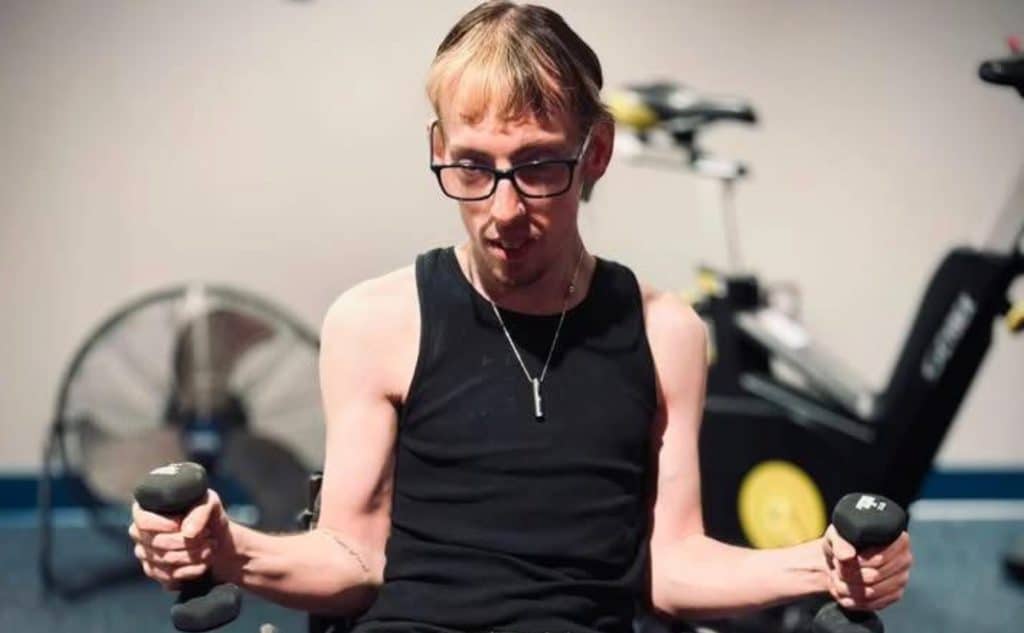
VanDyke has climbed a rock wall, tried adaptive ice skating, and traveled over rough ground using an all-terrain mobility device. He also competes in the Victory Games, an annual sports competition for people with physical disabilities, and serves on the organization’s board.
“Nowadays, I think I love sports because it gives you a sense of community and it gives you a chance to test your abilities,” says VanDyke, who uses a wheelchair and lives with cerebral palsy.
He also gets to be something he didn’t have as a child.
“It gives me a chance to be the representation that I didn’t have,” says VanDyke, who works as a peer mentor/graphic designer for Disability Network West Michigan.
‘Adventure for Everyone’
That opportunity to try is at the center of what Muskegon Luge Adventure Sports Park offers.
Dan Bonner, the park’s Outdoor Adventure Specialist, says staff members begin with one answer when someone asks whether they can participate.
Yes.
“Our attitude is, it starts with our tagline, ‘Adventure for Everyone,’ and we always start every single question of ‘Can I do this?’ with the answer yes,” Bonner says.
There are safety restrictions. Height and weight limits apply to everyone using certain attractions. After that, Bonner says the conversation becomes about what the person wants to do and what help, if any, they need to do it.
A person trying rock climbing may want to reach the top. Someone else may want to get a few feet off the ground. Another person may want to climb using adaptive equipment.
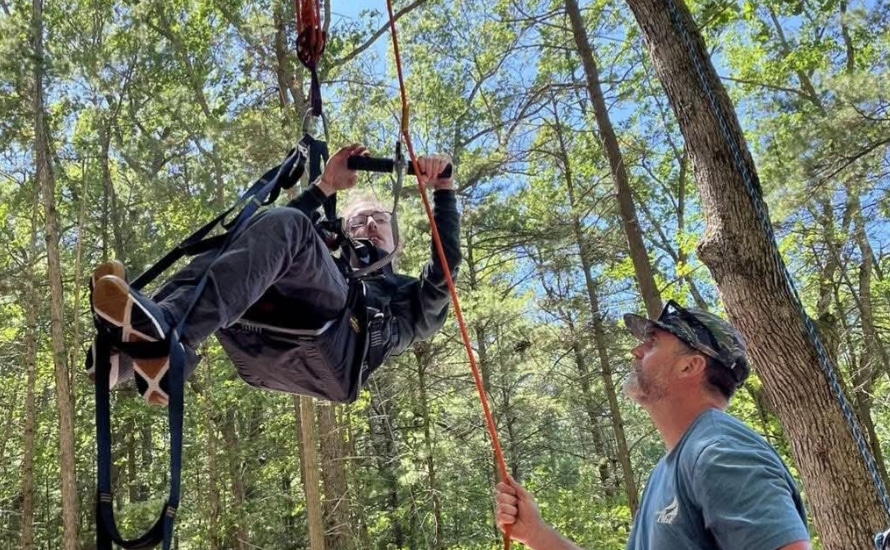
“We always start every conversation with the answer yes, but then we work with the individual, or, if the individual is unable to communicate for themselves, we work with the family, or the caretaker, the guardian, to adapt the activity so that the individual can achieve their goal,” Bonner says.
He notes staff recently helped two people who are paralyzed from the neck down and use ventilators participate in zip lining, luge and rock climbing.
The park offers recreation year-round, including zip lining, rock climbing, wheel luge, archery, and hiking during warmer months, and luge, cross-country skiing, ice skating, and snowshoeing in winter.
Respecting independence
Accessibility also goes beyond mobility.
The park recently worked with interpreters when the Muskegon Area Intermediate School District’s deaf and hard of hearing program visited. A $25,000 Lions Club grant is helping pay for another project using the RightHear app to help people who are blind or have visual impairments navigate hiking trails through audio directions.
The park also has found ways to give people more independence.
Staff members once held bows for participants who could not hold them on their own. Working with community partners led to an adjustable bow stand that can be positioned for someone using a wheelchair or sitting in a chair.
“They can adjust the bow to their height, and they can independently do archery where before they were relying a lot more on our staff members to help them,” Bonner says.
Staff training is another part of the work.
Bonner says Disability Network West Michigan has helped employees learn about communication, disability awareness, and respecting people’s independence. VanDyke has been among those providing that training.
One lesson sounds easy but can take practice: Ask before helping.
Bonner remembers assuming that someone using a wheelchair would need help getting up a steep ramp to an ATV. He learned that some people wanted assistance. Others didn’t.
“There are people that will do it themselves, and then there are people that would like the assistance,” Bonner says. “But we’re always cognizant of asking first before we’re just doing anything extra that we wouldn’t do for someone that isn’t using a wheelchair.”
Accessibility goes to camp
Camp Newaygo has been asking similar questions in a much different setting.
Camp Newaygo turns 100 this year. Its historic buildings and natural landscape, including hills, stairs and uneven terrain, can present accessibility challenges.
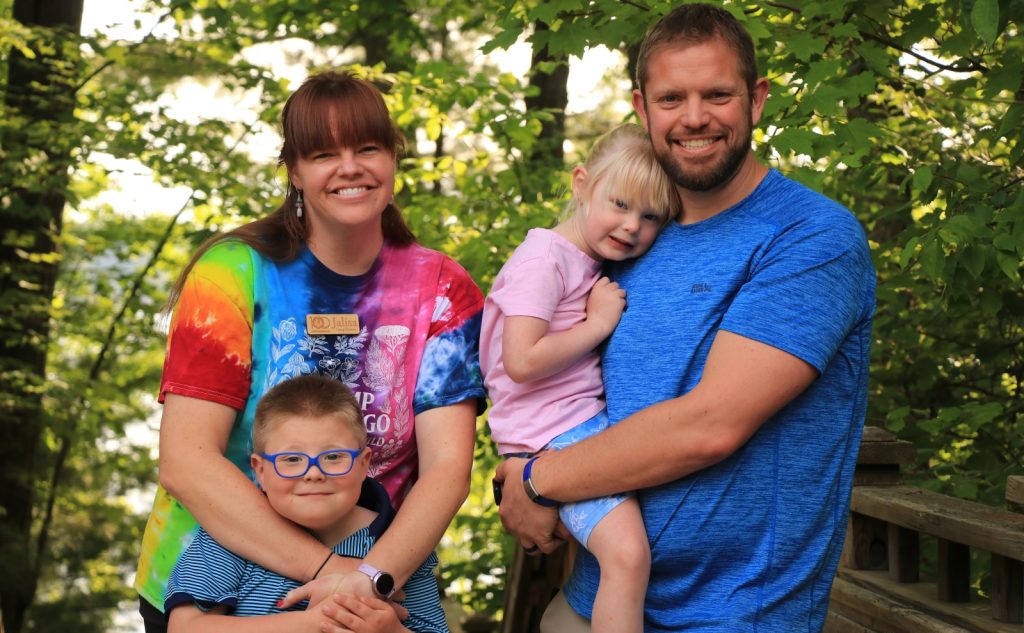
Camp Director Jalisa Danhof says staff focus on finding practical ways to remove barriers and help people reach places that might otherwise be difficult to access.
Sometimes a golf cart or van is the answer. Other times, it takes more creativity.
“What works doesn’t have to be expensive,” Danhof says. “It just has to work and be safe.”
When a student with limited upper-body mobility was coming to camp, staff wanted to find a way for the student to use one of its canoes.
Danhof called Disability Network West Michigan. The solution involved adapting a bath chair with PVC pipe to provide the support the student needed.
“I think we’re just trying to find adaptive ways to use these very unique outdoor features in a way that meets every person where they are,” Danhof says. “Every disability is different, and so what works for one individual is not going to work for the next.”
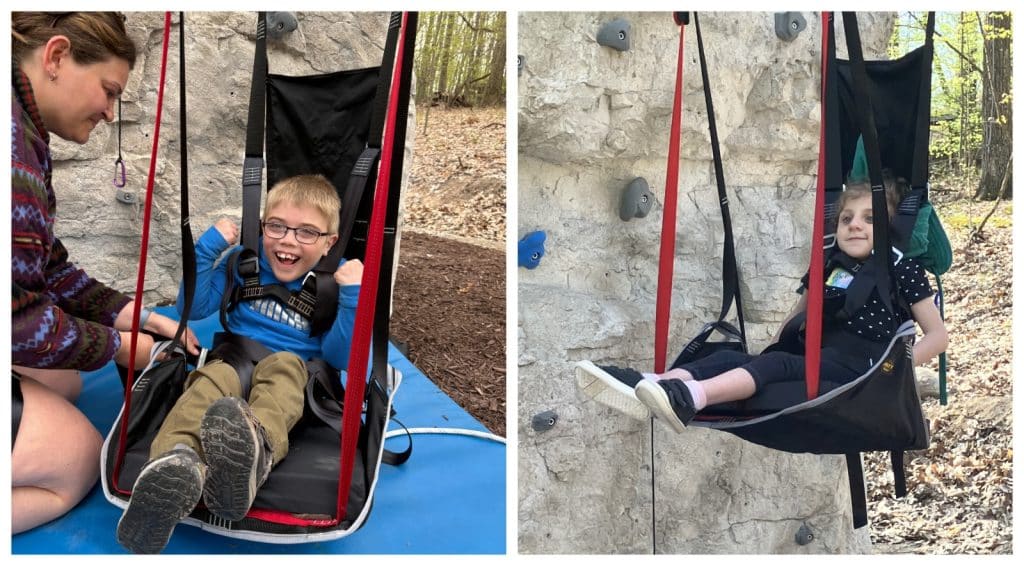
Camp Newaygo also added an adaptive rock wall in summer 2025. Danhof says one visiting school group included more than seven students who use wheelchairs. They were able to climb with their classmates.
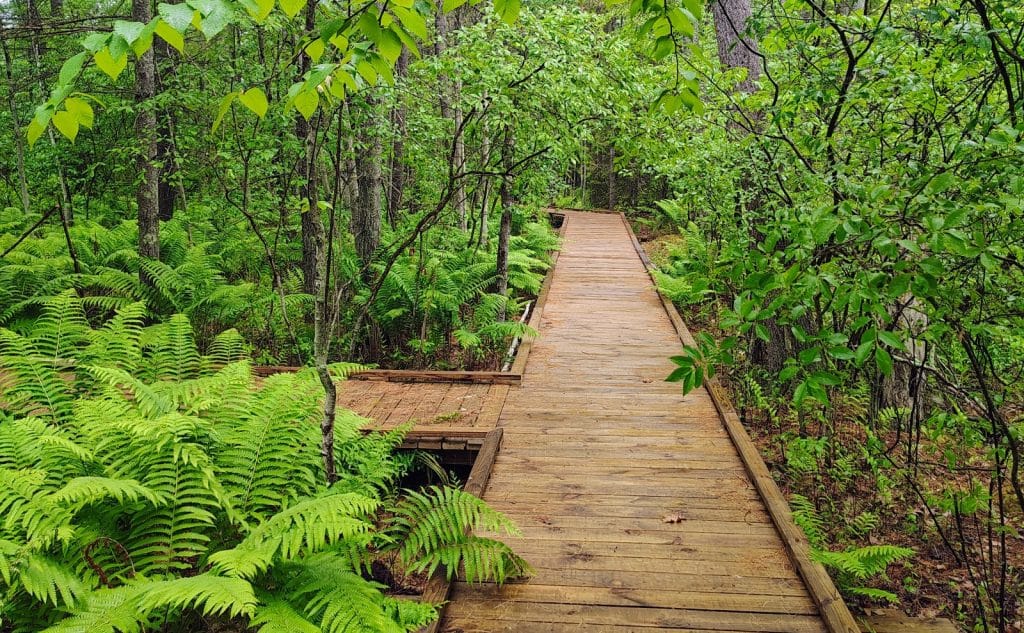
The camp’s biggest accessibility project is taking place in a bog.
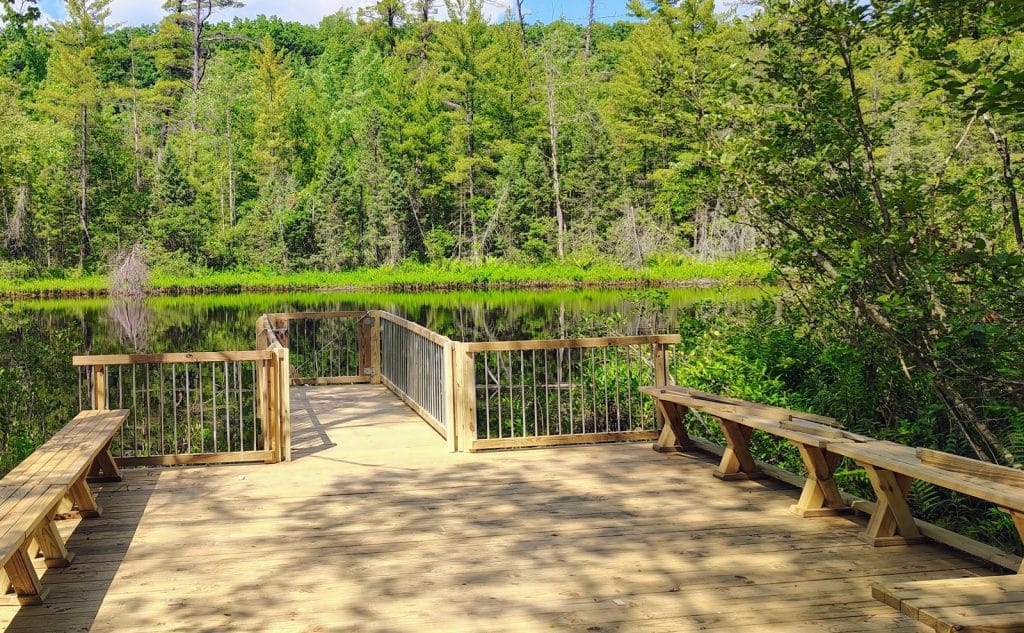
A human-caused wildfire damaged a boardwalk built in 1987. Camp Newaygo is rebuilding the roughly 1-mile trail with accessibility in mind.
That isn’t easy.
Heavy equipment cannot easily enter the wetland, so materials must be brought in another way. The trail also needs a grade that allows people using wheelchairs and walkers, as well as people with prosthetics, to travel safely.
Camp Newaygo asked Disability Network West Michigan to get involved before the work was finished. Representatives walked the trail, looked at turnaround areas, and talked about how people with different disabilities might use the space.
The goal is “really trying to bring in experts who understand the populations that we want to be able to use this trail right at the ground level, so that they can be part of the planning process,” Danhof says.
The trail is expected to open Oct. 22 and will be free to the public from sunrise to sunset throughout the year.
Individual needs
Neither Camp Newaygo nor Muskegon Luge Adventure Sports Park has an answer that works for everyone.
Bonner encourages people who may need an adaptation to contact the park before visiting. Staff can often accommodate someone who arrives without notice, but some activities require extra equipment or specially trained employees.
“It’s really just us being better prepared to provide the best experience for that individual,” Bonner says.
VanDyke knows that adaptive equipment doesn’t always work exactly as planned. He learned that when he tried adaptive ice skating.
VanDyke sat in a hockey sled and was given shortened hockey sticks to propel himself across the ice. He couldn’t get himself moving, so someone pushed him.
“I was able to be pushed on ice, and it’s just a cool thing to be on ice and get to experience what that was like,” VanDyke says.
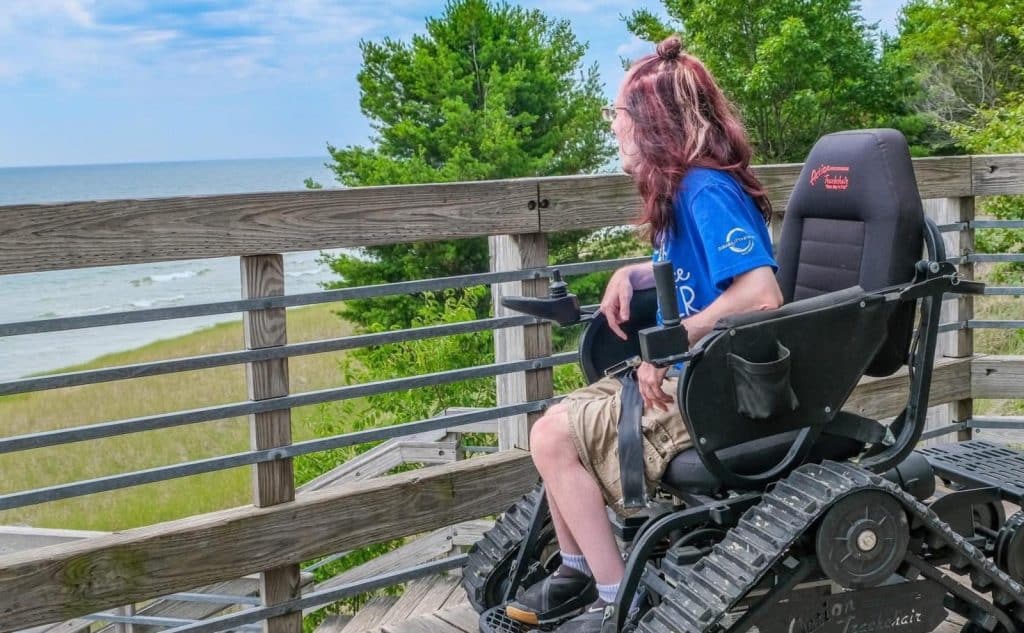
His experience with an all-terrain mobility device was different. This time, he could travel across terrain that would otherwise have been difficult to navigate.
“It gives you an opportunity to feel what no boundaries is like, the way it feels to just be able to go anywhere,” he says. “It kind of removes what a barrier-free life would be like.”
Models for youth
The work is personal for Danhof, too. Her son has special needs, and she says being his parent has added to what she has learned about accessibility.
“It’s near and dear to my heart to make camp as inclusive as possible for him,” she says. “That’s been a learning journey for me as a parent.”
VanDyke keeps coming back to the kids watching. He remembers growing up without seeing many people with disabilities doing the things he does now.
“A lot of people growing up with disabilities, they’re oftentimes told what they can’t do and what they won’t do,” he says. “But if they look at what I can do or what I’ve done, then maybe they can see a little bit of themself in it.”
That is what keeps him involved after nearly 25 years.
“If you have a room full of 10 or 12 disabled athletes, maybe they’ll see what’s possible instead of just the barriers,” VanDyke says. “I think, or I hope, it gives people hope of what could be instead of just what-ifs.”
Photos courtesy of Jeffrey VanDyke and Jalisa Danhof
The multi-regional Disability Inclusion series is made possible through a partnership with Centers for Independent Living organizations across West Michigan.
Author

Related Articles
Alpena builds accessibility roadmap by listening first, improving public spaces for everyone
Alpena’s accessibility assessment helps prioritize affordable improvements, showing small communities how resident input can guide inclusive planning and investment.
July ADA Celebration brings advocacy, resources, inclusion to Muskegon County communities
The free July 21 event celebrating the ADA’s anniversary connects residents with disability resources, assistive technology, voter information, and advocacy organizations.
How a gaming group created a friendship circle for people with disabilities
Disability Network Northern Michigan’s gaming group reduced isolation, inspired friendships, and even inspired an effort to create a nonprofit for railroad preservation.