Cal Langejans: The Music Man who shaped Holland’s sound
In this Shore Story, Bruce Hekman explores how Cal Langejans enriched Lakeshore communities through music, leadership, and a lasting legacy.
This is part of the Shore Stories: Life Along the Lakeshore series, which includes columns by local and former residents about how people are making a difference along the Lakeshore.
In a city filled with musical talent, a case can be made for Cal Langejans as Holland’s Music Man.
Over his long life and career, Langejans, 89, started and sustained the West Ottawa schools’ instrumental music program, the Holland Chorale, the Holland Symphony and the Evergreen Chorale.
He started as a fifth-grade drummer in Holland. After graduating from Hope College in 1958 with a degree in music education, he and his wife, Vonnie, spent a year in Ann Arbor, where he earned a master’s degree in music composition at the University of Michigan. They then returned to Holland, where he began working at West Ottawa Public Schools.
Although his training was in instrumental music, he’s always loved choral music and directed church choirs. Men’s choral groups were a big thing at many churches in the late 1950s, and Langejans founded the Holland Chorale in the basement of Bethany Christian Reformed Church with an auditioned group of men. Auditions weren’t common back then, but Langejans, in characteristic fashion, didn’t want to settle.
Most area churches had an evening service, and it was customary to have special music, either during the service or after. In addition to these Sunday evening programs, the chorale added a couple of performances throughout the year.
Women, in greater numbers than the men, also wanted to sing choral music, so Langejans started a separate women’s ensemble. Though the men resisted the change in the sound, eventually the women’s ensemble joined the men to become the many-voiced Holland Chorale.
Building on excellence
Langejans was always reaching higher and wanted to perform the best standard choral pieces, so the chorale began performing Bach’s Christmas Oratorio. This required an orchestra, including piccolo trumpets, so Langejans and his Holland instrumental director colleagues recruited area musicians. This was the genesis of the Holland Symphony.
Eventually, the chorale would perform half the concert and the symphony the other half, until eventually each group earned its own following.
Langejans and the chorale worked hard, performing multiple concerts over the course of the year, including several Tulip Time shows, which helped fund the group. Langejans was a tireless and persistent fundraiser and promoter of music in the community.
But he recognized his weakness as a conductor: He was trained for instrumental music. As the chorale gained momentum, Langejans realized he needed to learn more about choral music and conducting. He signed up for summer training programs with the best choral conductors in the Western world: Sir David Willcocks, Alice Parker and Anton Armstrong, to name a few.
He particularly admired the Robert Shaw Chorale and studied its performances to learn the craft of conducting great choral music. Before long, the chorale was performing ambitious season-ending programs with the Kalamazoo Symphony and the Grand Rapids Symphony.
They sent in audition tapes and were selected to perform at the annual state and regional conventions of the American Choral Directors Association and the Music Educators National Conference — a high honor!
To raise the community’s awareness of music culture, Langejans and his school colleagues started the March Festival of Arts in 1979, which brought national and international performing groups to all the elementary schools in the area every spring. He used his summer program contacts and his formidable persuasive skills to help finance this program, which continued for 24 years.
Langejans was passionate, persuasive and persistent. He loved his performers, and they loved him and each other. That was the “magic sauce” to their performances. Langejans believed that singing together built a strong sense of community among the 70 or 75 members of the chorale, and the love helped them reach “always a little higher.”
New challenges
After 30 years of multiple commitments, he retired from his role at West Ottawa in 1989 to devote himself to the Holland Chorale and the March Festival. After 40 years with the chorale, he retired, but within a few years, he was recruited by some of his former chorale members to start the Evergreen Chorale at Evergreen Commons, which he created and conducted for 15 years before retiring in 2016.
His long career culminated in his final concert with the Evergreen Chorale at the Jack Miller Concert Hall on the campus of his alma mater, Hope College.
Langejans and his wife will celebrate their 70th wedding anniversary on Oct. 18. The Holland Chorale will honor Langejans’ many musical contributions to the Holland area at its fall concert at 7 p.m. Saturday, Oct. 24, at Harderwyk Ministries. The chorale will perform three of Langejans’ favorite choral selections and invite former chorale members to sing with the current chorale.
Langejans can be found at the Evergreen Commons Fitness Center three days a week, following his doctor’s advice for the treatment of Parkinson’s disease. He doesn’t particularly like doing it, but in typical Langejans fashion, he’s determined to do what needs to be done. To pass the time, he listens to recordings of the Holland Chorale.
At home with his wife, he writes a monthly Grandpa’s Notebook email to their five children, many grandchildren and great-grandchildren, sharing his grandfatherly wisdom with those he loves. He’s deeply grateful for the blessings of his deep faith in God and the support of the Holland community over multiple decades of a remarkable musical legacy.
Photo courtesy of Dan Beerens
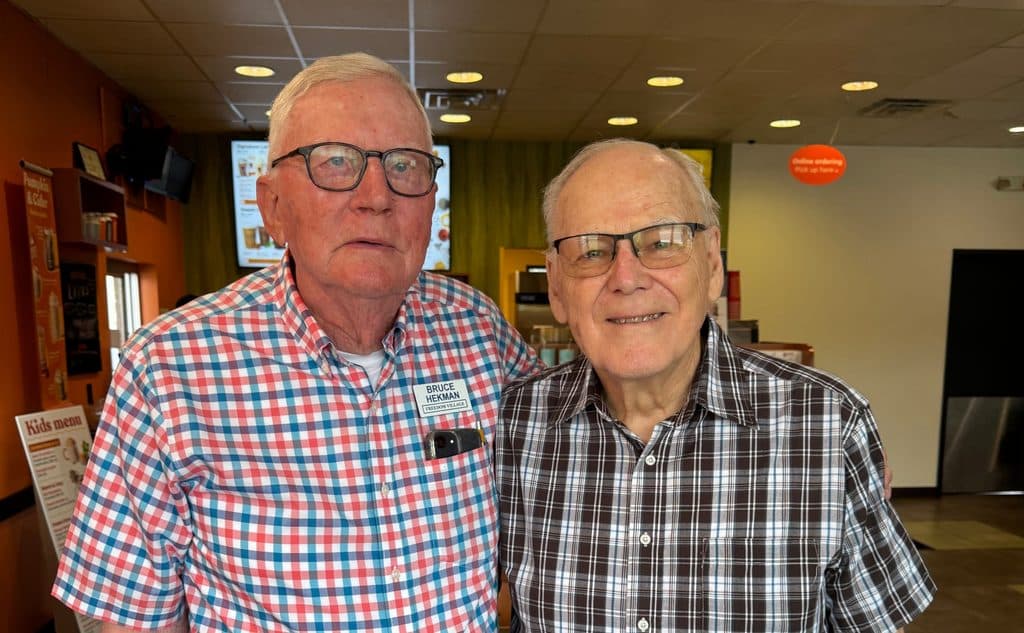
Bruce Hekman is a Holland resident, retired educator and freelance writer with a doctorate. He served as an English teacher and school head in Japan and Kalamazoo and currently edits the newsletter at Freedom Village.
Related Articles
Can “Poetry Saves Lives?” Festival shares how poetry benefits mental health
Free three-day event includes panel of local mental health professionals.
Holland to Holland tour connects residents with Dutch heritage
Holland to Holland tour takes West Michigan residents to the Netherlands to explore local history, cultural ties, and community traditions.
September things to do: Labor Day events, shopping, a Civil War re-enactment, and a beach groove
West Michigan Lakeshore communities are hosting Labor Day events, farmers markets are still in business, and there’s some good music, dance, and comedy in this month’s calendar.