Allegan County senior services help older adults manage life at home
Allegan County’s senior services help older adults stay home with meals, personal care, transportation, and support for their family caregivers.
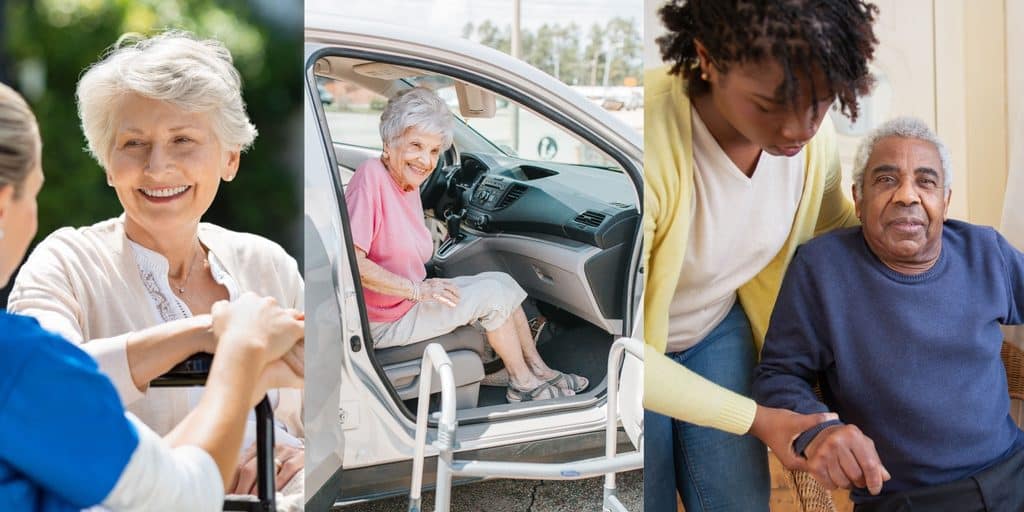
Patricia “Pat” Petersen can take a shower on her own. But having someone nearby in case she slips gives the 79-year-old Monterey Township resident a little more confidence.
An in-home worker can step in when she needs help. Delivered meals helped her eat well after a hospital stay. An emergency response device brought medical help when she feared she was having a heart attack.
“If I were to slip or something, or I feel I needed assistance, she would come in and help me with that,” Petersen says of her in-home worker.
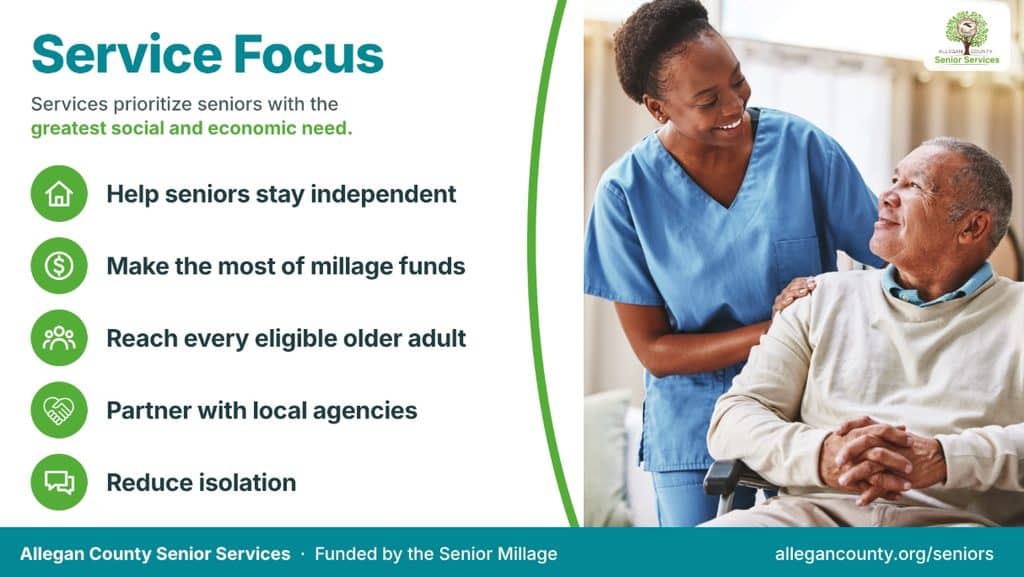
These services show how Allegan County’s senior millage helps older adults in daily life. That property tax pays for five programs that help them stay in their homes: meal delivery, emergency call buttons, help at home, rides, and adult day care.
“Our goal is to bring the supports in the home, keep them aging in place,” says Jenifer Garcia, the county’s director of senior and veteran services. She helps oversee the county’s senior services.
The Allegan County Commission on Aging and Senior Services oversees the senior millage. Its services help older adults live on their own, with dignity and a good quality of life.
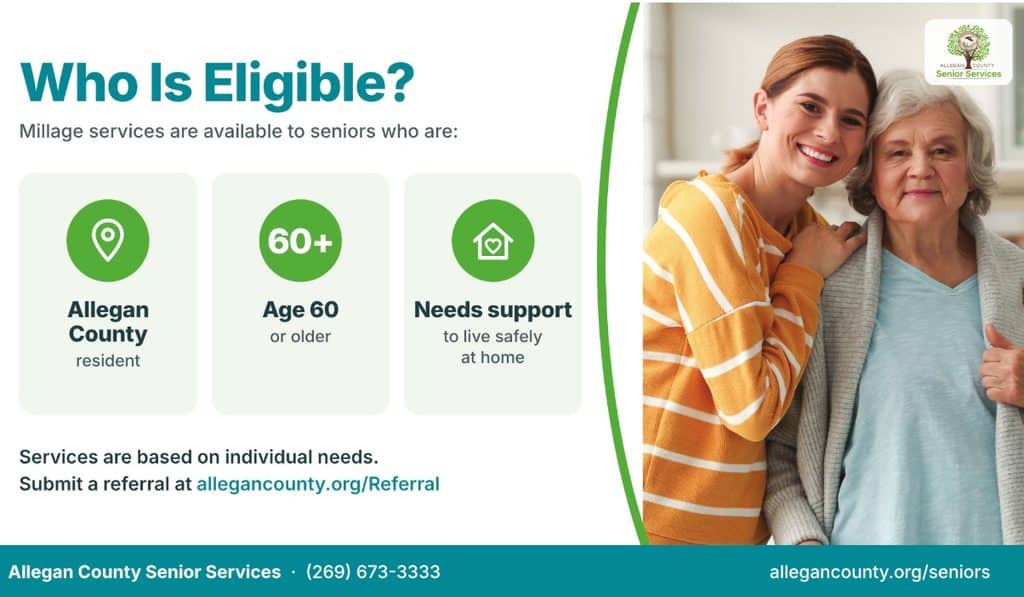
To qualify for services, residents must be at least 60, have lived in Allegan County for at least 60 days, and need help from these programs. The county does not check their income to decide if they qualify. Services funded by the senior millage generally are free, though residents pay a fare for county bus rides.
Garcia says the programs serve nearly 1,500 individuals each year.
Started 20 years ago
County voters first approved the senior services millage in August 2006. The Commission on Aging began in February 2007 and sought its first service contracts the following month.
The first programs offered group meals, home-delivered meals, adult day care, and rides from volunteer drivers. They also provided help with personal care, housework, and in-home care so family caregivers could take a break.
Later, the millage stopped paying for group meals. Help with personal care, housework, and breaks for caregivers became one program called in-home supports.
Voters renewed the millage in 2010 at its original rate of 0.24 mills, with about 68% voting in favor. The rate increased to 0.436 mills in 2014 and 0.439 mills in 2018. Personal emergency response systems were added in a later round of service contracts.
In August 2026, voters approved the millage for another four years with 72% support. The approved rate of 0.4753 mills amounts to about $100 annually for a home with a taxable value of $210,000.
Petersen sees the programs from two perspectives. She receives services and has served on the Commission on Aging for more than a decade.
She began helping older adults in the 1970s at the Mecosta County Commission on Aging, first answering phones and greeting visitors, then managing projects.
“I always knew I’d be lucky if I made it into the group,” she says. “Well, here I am.”
Petersen says she began receiving services from Allegan County about five months before she interviewed for the Commission position. Meals were especially helpful after she left the hospital and could not prepare them herself.
Home-delivered meals can help people who have trouble cooking, standing for long periods, or getting groceries. Residents can choose their meals, and delivery schedules can be adjusted to their needs. Temporary assistance is also available during recovery from an illness or surgery.
A doctor’s prescription is not needed for regular meals, though one may be required for certain liquid nutritional supplements.
Petersen’s emergency response device provided another kind of support.
One day, she felt heaviness in her chest and worried she might be having a heart attack. She activated the device, and emergency responders arrived and took her to the hospital.
It was not a heart attack, she says. But getting help answered her immediate concern.
“I had peace of mind knowing that,” Petersen says.
The county offers both traditional landline emergency response systems and wearable devices that use cellular service and GPS to connect people with help, even away from home.
Personal care provided
In-home support begins with an assessment to develop a care plan. Help can include bathing, dressing, grooming, and respite care that gives family caregivers a break. Housekeeping and meal preparation may be included, but housekeeping is not available as a stand-alone service.
Garcia says personal care can be as simple as having someone nearby while a person showers, as Petersen does.
Workers can also prepare lunch, wash clothes, or change bedding during their visits.
“They can do all of those things and still make sure you’re safe while they’re inside the home,” she says.
Visits can total up to nine hours a week, Garcia says. Staff also help residents find other programs when they need more care, such as adult day services and help with personal care. Services are offered at Generations in Allegan and The Day Center of Evergreen Commons in Holland. The county can help arrange rides.
Senior transportation offers rides to medical and legal appointments, grocery stores, and other errands. Medical trips have priority.
Garcia says seniors can ride Allegan County Transportation buses within the county for $1 each way. Eight volunteer drivers also use their own vehicles to take older adults to medical appointments, including trips outside the county.
“Those eight drivers travel over 92,000 miles a year taking seniors,” she says.
The county reimburses volunteers for mileage. Drivers can also help passengers enter and leave their homes and carry packages.
When a passenger needs an accessible vehicle, the program can arrange a county bus at no additional charge for the medical trip, Garcia says.
“We’re seeing the demand increase, but our volunteer drivers are helping pick up the majority of that demand,” she says. The county needs more volunteer drivers, she adds.
Learn about program before you need it
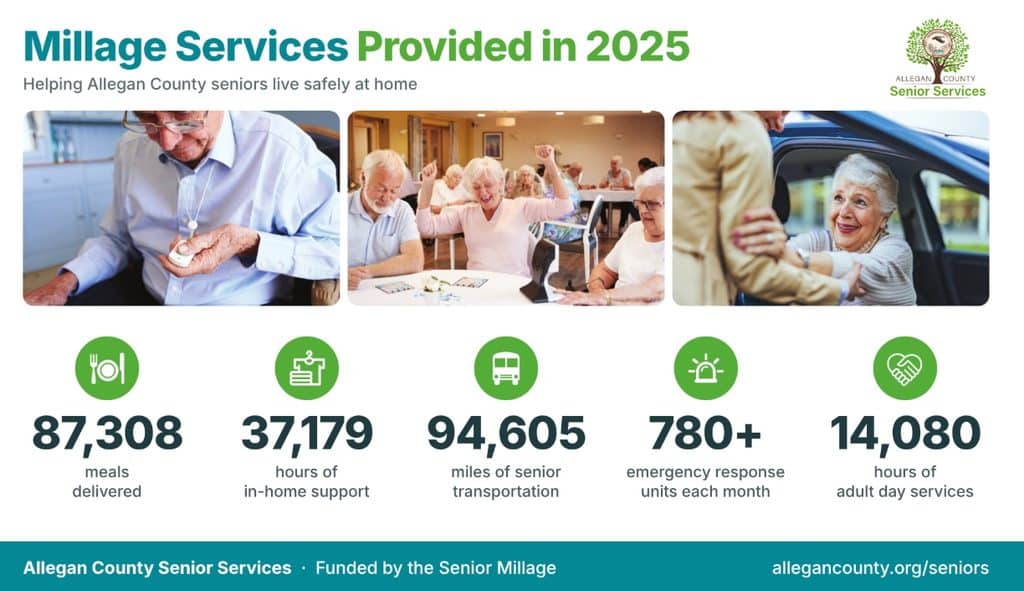
In 2025, programs funded by the senior millage delivered 87,308 meals and provided 37,179 hours of help in people’s homes. They also provided 14,080 hours of adult day care. Drivers traveled 94,605 miles to take seniors where they needed to go.
But some residents may have to wait for services because there are not enough workers. Even if someone qualifies for in-home help, a worker may not be available right away.
Petersen also would like the Commission to provide help with snow shoveling and lawn mowing for seniors who cannot do the work themselves or can’t afford to pay for it.
Garcia urges families to learn about services before they need help.
“We try to encourage people to reach out before you even think you need the services,” she says.
To ask for help, call Senior Services at 269-673-3333 or fill out the county’s online form.
For a ride, call 269-686-5164 three to five business days ahead.
Petersen says voting to fund these services shows that residents care about their older neighbors.
“And that tells me that Allegan County cares about their seniors,” she says.
Author

Related Articles

Muskegon veteran uses national title to address women veterans’ homelessness
Muskegon resident Zaneta Adams, named Ms. Veteran America 2026, aims to connect women veterans with housing resources and a supportive community nationwide.
Spring Lake Township builds community engagement: ‘We walk the walk’
In this Shore Story, Beth Anne Piehl shares how Spring Lake Township connects residents through learning, listening, and volunteer service.
Michigan’s community mental health system: Overcoming stigma to provide needed care
Community mental health has played an important role in shifting the culture to asking for help.