Hope College, city of Holland collaborate on award-winning public tree database
Students and interns played a key role in mapping 15,000 trees across Holland and the Hope campus, expanding biodiversity, sustainability education, and canopy access.
Michelle Gibbs remembers when Hope College students first walked alongside city workers through Holland’s streets and parks carrying tablets and recording trees.
What started in 2018 as a small project between Hope College and the city of Holland has grown into a public database tracking nearly 15,000 trees. The effort also earned Holland and Hope College international recognition for their work in urban forestry and sustainability.
The group recently received level II accreditation from the ArbNet Arboretum Accreditation Program and The Morton Arboretum. The award honors communities that support tree diversity, public education and urban forestry. To earn this accreditation, the group must identify and label at least 100 tree species and show strong work in education, tree care and long-term planning.
Hope College and the city of Holland each documented more than 100 tree species during the project, which Gibbs says gave students and residents a chance to learn about the environment while working together as a community.
“It’s been a long process, but it’s been a lot of fun and really exciting to be able to pull in a lot of different partners to be able to make it happen,” Gibbs says.
The project was led by Hope College’s biology and computer science departments and the city’s parks and Geographic Information System, or GIS, teams. Hope students and city interns walked through neighborhoods, parks and campus paths to identify, measure and map trees. Their work helped create a public database with nearly 15,000 trees across the city and Hope’s campus.
Documenting the urban forest
Gibbs says the idea came from retired Hope College biology professors Greg Murray and Kathy Winnett-Murray.
“They had come to me with an idea about helping to inventory the trees on campus and helping people better understand the true environmental benefits of our ecosystem and ecosystem services that our trees provide to us,” Gibbs says.
At about the same time, the city was exploring ways to better document and manage its urban forest.
“Leveraging us all working together really made the most sense to not recreate the wheel,” she says.
The work became a multiyear effort involving faculty, sustainability leaders, student interns, arborists and city GIS specialists. Early in the process, students walked neighborhoods, parks and campus pathways, cataloging tree species, measuring trunk diameters and recording GPS locations. The city’s GIS department provided mapping tools.
“We had one super fantastic student who was working with us, and she was well-versed in tree identification,” Gibbs says. “She really just took the project and ran with it.”
Hope students expanded the inventory each summer and updated records as trees were removed, replanted or affected by construction projects. The college’s computer science department also helped create an interactive platform that made the data available to the public.
Jamie Scott, city deputy director of parks and cemeteries, says the collaboration succeeded because multiple organizations shared a long-term vision.
“It was pretty neat,” Scott says. “As with anything, collaboration is always the best when you get to work with somebody who has a shared vision.”
Available to residents
The inventory allows residents to identify individual trees by species and size and measure environmental benefits such as carbon sequestration, oxygen production and stormwater interception. The GPS-enabled system allows users to access information while walking through parks, neighborhoods or the campus.
Residents can use the database to identify tree species they admire during spring blooms or autumn color changes and learn more about which species might work well in residential landscapes.
“It’s really fun once you start kind of getting around to springtime and in the fall time, when you see the trees at their peak performances,” Gibbs says. “You can find out what kind of tree it is, and you’re like, ‘Oh, I’d love to be able to have that at my house.’”
The inventory also highlights how trees contribute to environmental resilience in urban settings.
“There are a lot more benefits that trees offer to us,” Gibbs says. “They help clean particulate matter out of the air, they help a lot with soil stabilization and stormwater infrastructure.”
Scott says the project helps residents understand the cumulative impact of maintaining a healthy urban canopy.
“Everybody loves to go to a park that has shade,” Scott says. “Nobody goes to the park to have full sun. That’s what the beach is for.”
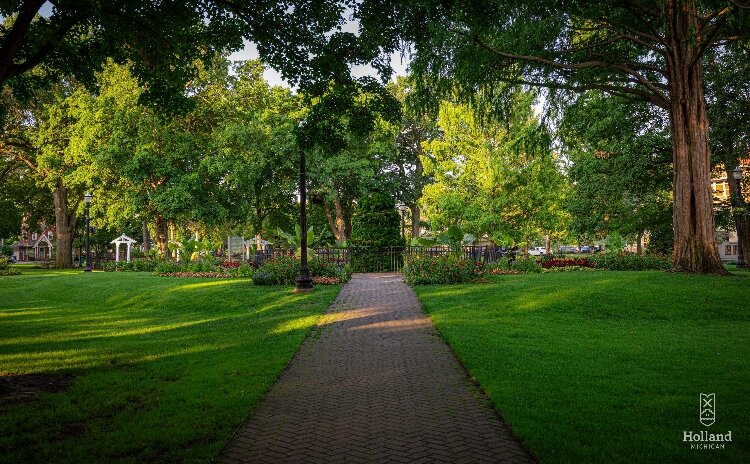
One of Holland’s best examples is Centennial Park, home to some of the city’s oldest and most historically significant trees.
“Centennial Park has historically been a hub of the city, and there are a lot of historic trees in that park,” Scott says.
Among them are large dawn redwoods, relatives of California’s giant sequoias.
“Some of the largest in the state can be found in Centennial Park and in our cemeteries,” Scott says.
Promoting healthy diversity
The accreditation process required extensive documentation and planning.
“One of the biggest pieces of level two was making sure that you had 100 unique species that were inventoried,” Gibbs says.
The focus on biodiversity reflects growing concern among forestry experts about monocultures, or urban landscapes dominated by too few species. Scott says communities across the country have already experienced the risks of relying too heavily on one type of tree.
“The emerald ash borer decimated the ash trees,” Scott says. “We want to kind of avoid maple trees and planting of maple trees if we can, just so we don’t have another monoculture.”
Gibbs says biodiversity also supports wildlife habitat and long-term environmental stability by reducing the impact of diseases or infestations.
“We’ve seen that over the years,” Gibbs says. “(In a monoculture,) it can just obliterate your canopy tremendously.”
The city plants between 200 and 250 trees each year, with an emphasis on maintaining a healthy and diverse urban forest. The city also works with organizations including Grand Valley State University and the Outdoor Discovery Center Network to identify areas with limited tree canopy.
“We plant a variety of species in those areas just to get some trees and get some growth on there,” Scott says.
‘Trees are the answer’
Gibbs says the project has become an educational tool for students. Hope College employs sustainability interns who work on projects involving conservation, recycling, environmental justice and campus operations.
“I think starting with kids at a younger age, that’s really important to get them to understand how important it is to care for our environment,” Gibbs says.
She says the new accreditation creates opportunities to involve more local schools and younger students in environmental education and tree stewardship.
The recognition also reflects Holland’s broader sustainability culture. Hope College recently achieved gold-level sustainability status through the Association for the Advancement of Sustainability in Higher Education, while the city has maintained Tree City USA status for nearly five decades.
Scott says the community’s investment in trees reflects a larger commitment to quality of life.
“Trees are the answer,” Scott says.
Gibbs says Holland’s size makes the achievement stand out.
“For being a small town and a small school, we really stack up pretty highly with some of these larger communities,” Gibbs says.
Scott says the accreditation reflects what can happen when organizations work toward a common goal.
“You can’t get anything done on a big scale unless you have two parties that share the same vision,” Scott says.
More information about the accreditation program is available through ArbNet.org.
Author

Related Articles
The Land Conservancy’s 50-year fight to save West Michigan’s natural areas
The Land Conservancy of West Michigan celebrates a half-century of working to keep nature nearby.
Startup tackles food system inefficiency with direct farm-to-home delivery
Zeeland-based Locavana expands delivery, helping residents buy local food easily while increasing farmer earnings and improving access across West Michigan communities.
GVSU students turn old tech troubles into trusted local resale solutions
GVSU students solve risky, wasteful tech resale by building a trusted local model that improves safety, transparency, and sustainability.