
West Michigan author John Wemlinger draws inspiration from Lake Michigan shoreline
27-year Army veteran John Wemlinger draws on military experience, Lake Michigan locales for his award-winning novels, which connect with readers through familiar landscapes and free online previews.

The Lake Michigan shoreline is often the setting of John Wemlinger’s novels.
Communities along the Lakeshore are also where he finds readers who appreciate the role this geography plays in his books. He’s speaking about his work at libraries in communities such as Muskegon, Grand Haven, and Montague.
“All but one of my novels is set along that shoreline because it is some of the most beautiful geography in the world,” he said. “But another major reason … is I am familiar with it.”
Before turning to writing, Wemlinger spent 27 years on active duty in the U.S. Army. A Vietnam veteran who retired as a colonel, he logged more than 1,000 hours as a helicopter pilot and later served overseas in Germany, Japan, and Hawaii. After retiring from the military, he worked in public education with at-risk youth before stepping away in 2012 to focus on writing.
Since then, he has published six award-winning novels, including The Cut, which was named a Michigan Notable Book.

When he wrote Winter’s Bloom, his first novel, Wemlinger stayed alone at a lakeshore cottage in winter as a storm rolled in.
“It was just my dog, Sydney, and I,” he said. “We didn’t see another soul during our stay. It was exactly the kind of lonely place the book’s main protagonist was seeking.”
The book, set at Little Point Sable, explores PTSD, one of several issues tied to military life.
“I aim to identify an issue in each book that is affecting our military/veteran communities,” Wemlinger said. “One of my primary purposes … is to educate the general public on these important issues.”
His stories often connect with readers who recognize that landscape.
“What I’ve learned is that the setting for a book is extremely important,” he said. “Some enjoy discovering new places, while others prefer stories set in familiar settings they can relate to.”
Readers can get a start on those stories online. Through his website, www.johnwemlinger.com, the first four chapters of each of his novels are available to read at no cost.
The Lakeshore caught up with Wemlinger to learn more about his connection to this region and how it influenced his books.
The Lakeshore: You’ve spent time speaking at libraries in Muskegon, Montague, and Grand Haven, and your novel Winter’s Bloom is set along the Lake Michigan shoreline. How has that setting influenced your writing?
John Wemlinger: All but one of my novels is set along that shoreline because it is some of the most beautiful geography in the world. But another major reason I set my books against a Lake Michigan backdrop is I am familiar with it. I live in Onekama, and I am a frequent visitor to my sister-in-law’s cottage at Little Point Sable. In fact, when I was writing Winter’s Bloom, I spent three days there in the dead of winter. It was just my dog, Sydney, and me. I wanted to see if the lakeshore was as empty and desolate as I imagined. And it was. We were there as a big storm came in and dumped over half a foot of snow on us. We didn’t see another soul during our stay. It was exactly the kind of lonely place the book’s main protagonist was seeking.
TL: You’ve spoken with audiences along the Lakeshore (Ottawa, Allegan and Muskegon counties). What stands out to you about how readers connect with your work?
JW: What I’ve learned is that the setting for a book is extremely important. Of course, a good story must have intriguing characters involved in an interesting plot, but if they aren’t placed in the proper setting … Well, the book won’t have the pizazz to hold the reader’s interest. Why? The answer will vary among readers; some enjoy discovering new places, while others prefer stories set in familiar settings they can relate to.
TL: Your book, The Cut, was named a Michigan Notable Book. What did that recognition mean to you as an author?
JW: The publishing business today is highly competitive. When I talk to readers, I tell them, “There’s good and bad news about publishing a book. The good news is that anybody can publish a book today. The bad news is that anybody can publish a book today.” So, how does the reader determine if a book is worth their hard-earned money? One answer is to look to see if it has won any awards. All of my books have won awards for excellence in writing, but the Michigan Notable Book emblem on the cover of The Cut is my most prestigious award. Twelve judges, 300 to 400 books entered annually, and the State Library of Michigan only chooses 20 each year. It’s a big feather in any author’s cap to be a Michigan Notable Book author.
TL: Your upcoming novel, Finding Innocence, addresses sexual harassment and abuse in the military. What drew you to that subject, and what do you hope readers take away from the story?
JW: Over 50 years ago, just after the end of the Vietnam War, the Army was changing rapidly. We had become an all-volunteer force, and women were being recruited at much higher numbers than ever before as we opened occupational specialties that had previously been closed to them. But all the military services were ill-prepared for what this expansion of women into the force required. One of the biggest issues was managing “the birds and the bees.” As a young captain commanding a company at Fort Eustis, Virginia, in 1975, this issue hit me full force when six female soldiers came to me complaining they were being extorted in their academic classroom, sex for passing grades. Here we are 50 years later, and the problem is still manifest. It is, I believe, important to note that sexual harassment and abuse are not just limited to our military. Unfortunately, it happens across the entire spectrum of our society. Unchecked, it can destroy lives. Finding Innocence is an examination of the issue and the courage to stand against it.
TL: After a long career in the Army and later working with at-risk youth, what continues to drive you to tell these kinds of stories?
JW: My 27-year military career allowed me to live in parts of the world where most people count themselves lucky if they can simply say, “I visited there once.” I was given the opportunity to command companies, a battalion, and a brigade, and to learn to work with people of every kind of race, religion, creed, color, etc. It taught me when it was time for me to be directive and when I should just shut up and listen. I learned not to pretend to be the smartest person in the room and to seek the advice of others. Later, after my retirement, and working with at-risk youth at The Michigan Youth Challenge Academy, I saw firsthand the impact that military discipline, structure, and routine can have on young adults who have lacked those things in their lives. I owe the military a lot, and now, my writing is just one of the ways I can pay it forward.
Author

Related Articles
April things to do: Egg hunts, Earth Day events, spring break activities, concerts, and fundraisers
Art exhibits, musical shows, theater, and spring break activities are on tap for April. Easter and Earth Day events abound, as do movies, crafts, theater, concerts, and fundraisers.
Mountainfilm on Tour brings films, art, and movement to Saugatuck
Mountainfilm on Tour returns to Saugatuck this Saturday for a daylong festival with short documentaries, movement sessions, art, and food.
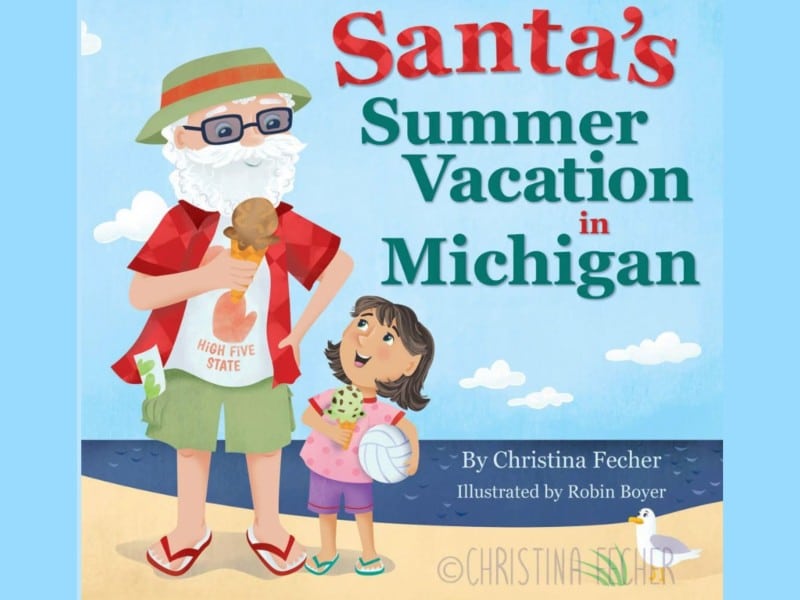
Muskegon author’s longtime dream comes true with published children’s book
After a decade of determination, Christina Fecher celebrates her debut children’s book, Santa’s Summer Vacation in Michigan, and inspires others to pursue long-held creative dreams.