Allegan County nears broadband completion, expanding internet access to all
The expansion of broadband service in Allegan County has had transformative impacts on health care, safety, education, and future growth.
Stephanie Calhoun bought her home in rural Allegan County for privacy and space for her family. What she didn’t expect was that her house was missing one piece of modern infrastructure: reliable internet service.
“It was insanity that we lived in a civilized nation with absolutely no internet access,” says Calhoun, president and CEO of the Allegan County Community Foundation. “We moved here in 2020, and I was shocked. My parents live about a mile away. They have had internet since 2000.”
Calhoun’s situation came at one of the worst possible times. The COVID-19 pandemic had shut down schools and offices, forcing her three children into virtual classrooms and her and her husband to work remotely.
“We tried everything,” she says. “We paid $400 a month for the worst internet service. The kids kept getting kicked out of chemistry class. Eventually, we tried T-Mobile’s cellular service for $50 a month. That was wonderful. But when fiber came down the road, that changed everything.”
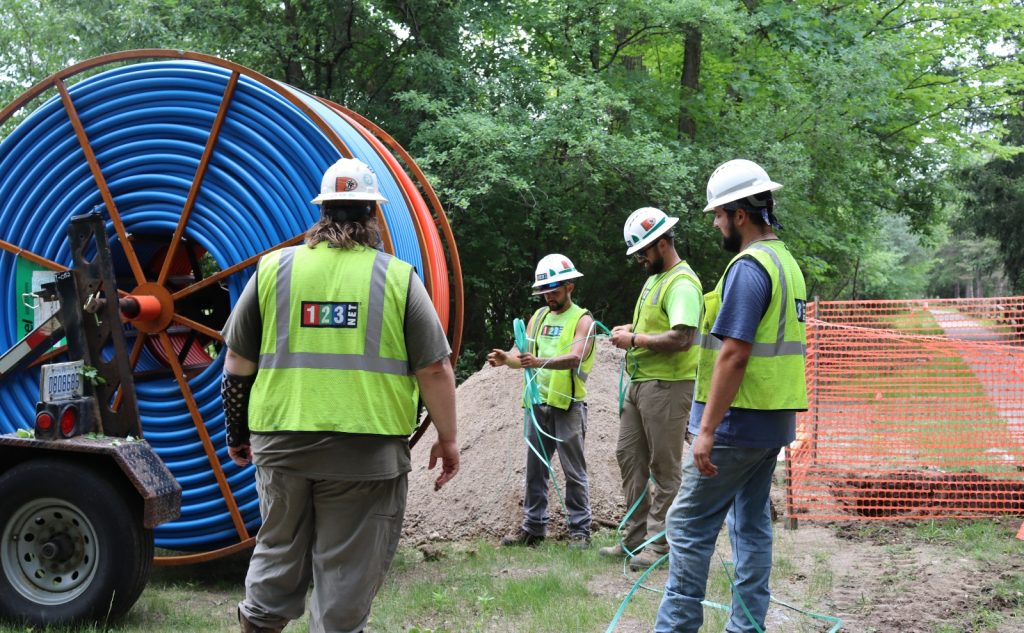
Once 123NET installed the fiber line, Calhoun says, life changed.
“Our internet works. It’s super easy. Once they installed it, we just paid the monthly bill. It’s beautiful,” she says. “I can work from home, my husband’s doing Zoom calls, and our kids are gaming online.”
Calhoun’s experience is now becoming the norm in Allegan County because of two major federal programs that aim to bring high-speed fiber internet to nearly every home.
Federal funding fills the gap
The first phase of the county’s broadband buildout came through a grant from ROBIN, Realizing Opportunity with Broadband Infrastructure Networks. Funded by the federal government but administered by Michigan’s High-Speed Internet Office (MIHI), ROBIN has provided millions to connect underserved and unserved areas.
Allegan County officials knew broadband was more than a convenience: it was a lifeline for education, healthcare, work, and safety. So the County Commission approved a resolution to commit the ARPA (American Rescue Plan Act) funds to water and broadband infrastructure projects and put out a Request for Proposal (RPF) for wired internet solutions. One of the eleven companies that responded was 123NET, the Michigan-based internet service provider now leading Allegan’s fiber expansion.
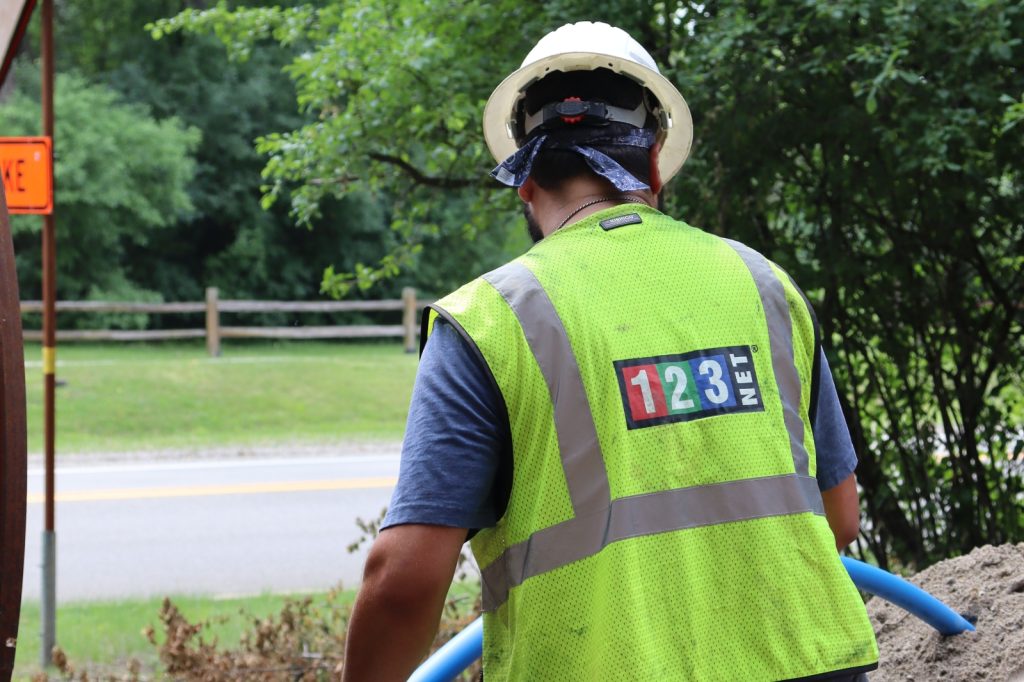
“Allegan was extremely proactive,” says Justin Lampman, chief operating officer of 123NET. “Their RFP attracted companies like ours to partner with them for that grant, and we are very grateful to be selected to work with them. Allegan County has been a true partner in the project and excellent to work with. “
“Many Allegan consumers connecting with fiber broadband today had no other options,” Lampman says. “Some were on satellite connections that were very slow, which made it difficult to do video calls or stream anything. The focus of this grant was on connecting people and communities who didn’t have any access to good connectivity.”
The new access has had an immediate effect, especially for those who have more trouble getting out of the house and getting access to their doctor. Being able to do that from home is critical, Lampman says.
As of this fall, construction under ROBIN is roughly 70% complete, and 123NET expects to finish by year’s end.
Built to last
123NET’s approach is designed for the long haul. Being purpose-built to serve Michigan, 123NET has a mission to ‘make Michigan Businesses and communities the best connected on the planet.’
“By building underground fiber optic infrastructure throughout the county, we are building and maintaining an infrastructure that will last decades,” Lampman says. “Everyone who connects will have a dedicated fiber line all the way up to their house.”
Customers can sign up for a range of options, starting with a base plan of 250 megabits per second for $59 a month. Higher speeds of up to 6 gigabits are available for homes or businesses with heavier needs.
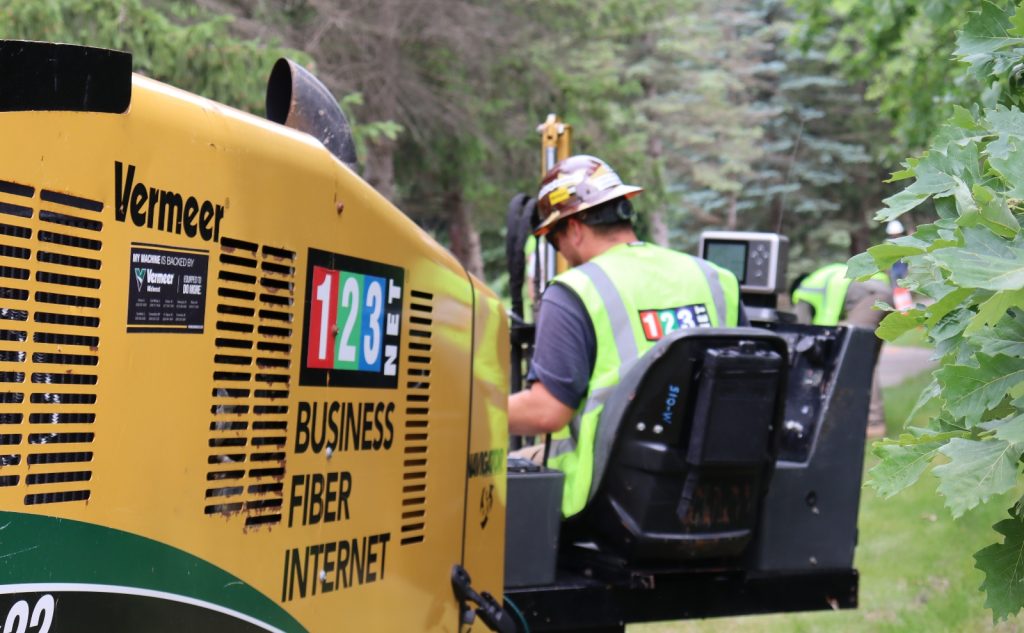
Residents can check their address and pre-sign up on 123NET’s website to be notified when the area is ready, which is the fastest way to sign up. Once an area is live, residents will also get mailers letting them know they can join.
The second phase of Allegan’s broadband expansion comes through BEAD, the Broadband Equity, Access and Deployment program. Like ROBIN, it’s federally funded and state-administered. But BEAD targets the gaps ROBIN can’t reach.
BEAD funding comes from the 2021 Infrastructure Investment and Jobs Act, which set aside $42 billion nationwide for broadband. The goal is to provide universal access to high-speed internet, defined as at least 100 megabits per second download speeds.
Immediate benefits
Jill Dunham, Allegan County’s broadband project manager, says the work is making a difference in people’s lives. One example is telemedicine.
“There was a woman who called me because her husband was having cancer treatments,” Dunham says. “He had to travel to Grand Rapids for prep sessions that could have been done over the internet. But because they didn’t have internet, he had to travel back-to-back days while exhausted from treatment. That one broke my heart.
“He wouldn’t have had to go back-to-back days if they’d had a connection.”

At this year’s Allegan County Fair, Dunham saw how residents feel about their new access.
“123NET had a booth there the last three years,” she says. “But this year was the first time when a lot of people already had service. Many people stopped by just to express their gratitude. They were so thankful to have good internet.”
The difference is visible not just in homes, but in the economy.
“There’s a property management company in the Lee Township area that’s buying land and rehabbing properties,” Dunham says. “They’re building an executive retreat center, and they couldn’t do that without the internet. Now they can. That kind of investment builds the community.”
Beyond convenience and business growth, broadband improves safety.
“The cell phone coverage in Allegan County is OK on the main roads,” Dunham says. “But when you get off the track, there are dead spots. That becomes a safety issue because the phones don’t work. When you have internet, even if cell coverage isn’t great, you can use Wi-Fi calling and actually get help. So it’s a safety issue, too.”
Top technology
But not all internet is the same. While satellite services like Starlink can provide short-term relief, Dunham explains why fiber is essential for the future.
“You can’t do gigabit on Starlink,” she says. “Gigabit is 1,000 megabits per second. The minimum to be considered high-speed is 100. Residential users can get by with 100 or 200, but businesses and community anchor institutions need gigabit. Starlink has been a great tide-over technology,” she says, “but you really need that wired connection. Fiber is dedicated. You’re not sharing it with anyone else. Cable and satellite are shared, so if too many people subscribe, it bogs down.”
The BEAD program was intended to build infrastructure for the long haul. “If we make that investment, we create jobs and infrastructure,” Dunham says. But she worries about shifting federal priorities.
“Howard Lutnick of the Department of Commerce announced in June that there was not going to be a preference for fiber,” Dunham says. “That means more funding might go to satellite systems. It’s really sad because those aren’t long-term solutions.”
Even so, she says, Allegan County is fortunate.
“The number of people affected by that in Allegan County is minimal,” Dunham says. “We took full advantage of the ROBIN grant. The rest of the state has a lot more gaps.”
Even with near-total coverage, Allegan County isn’t stopping.
“One of the other things that this fiber has made possible is that we’re in conversation with 123NET right now about bringing Wi-Fi to all of our parks,” Dunham says. “It’s partly so people can call 911, but it also allows them to pay fees using their phones. We can even install camera systems to improve safety and reduce vandalism.”
The next challenge, Dunham says, is maintaining Allegan’s rural character as it becomes more connected.
“We want to keep the culture of Allegan County,” she says. “We don’t want it to become too dense and lose our farmland and trees. But it’s a desirable place, and because we have internet, it’ll be even more desirable.”
As fiber spreads across the county, residents like Calhoun are grateful.
“I didn’t even know there were places without internet in 2020,” Calhoun says. “When I worked at the library, I thought the ‘digital divide’ was about affordability. I didn’t realize it could mean total absence. Now that we have real internet, it feels like our home has finally joined the modern world.”
Photos provided by 123NET.
Author

Related Articles

Holland Rotarian takes AI expertise to global stage
Charles Elwood addressed Rotary International, sharing how artificial intelligence can strengthen service, amplify voices, and build community connections worldwide.

Lakeshore Advantage adds board members, outlines regional growth strategies
Economic development group highlights expansion projects, startup support, and workforce initiatives while appointing four leaders to guide regional growth.
Partner Partner Content “When I grow up.” Inspiring kids to dream big about careers in health care
These collaborations show how growing interest in health care careers can begin early.