Allegan Area ESA playgroup connects families through shared challenges
An Allegan Area ESA social worker created a playgroup uniting families of young children with disabilities for connection, inclusion, and support.
Alayna Krueger, a social worker who assists young children with significant medical and developmental needs, noticed a pattern among the families she served: parents often felt alone.
“These families kept saying the same thing,” says Krueger, part of the Allegan Area ESA’s Early On program, which serves children from birth to age 3. “They’d tell me, ‘I don’t know anybody else going through this.’ Their kids deserved a space where they belonged, and so did their parents.”
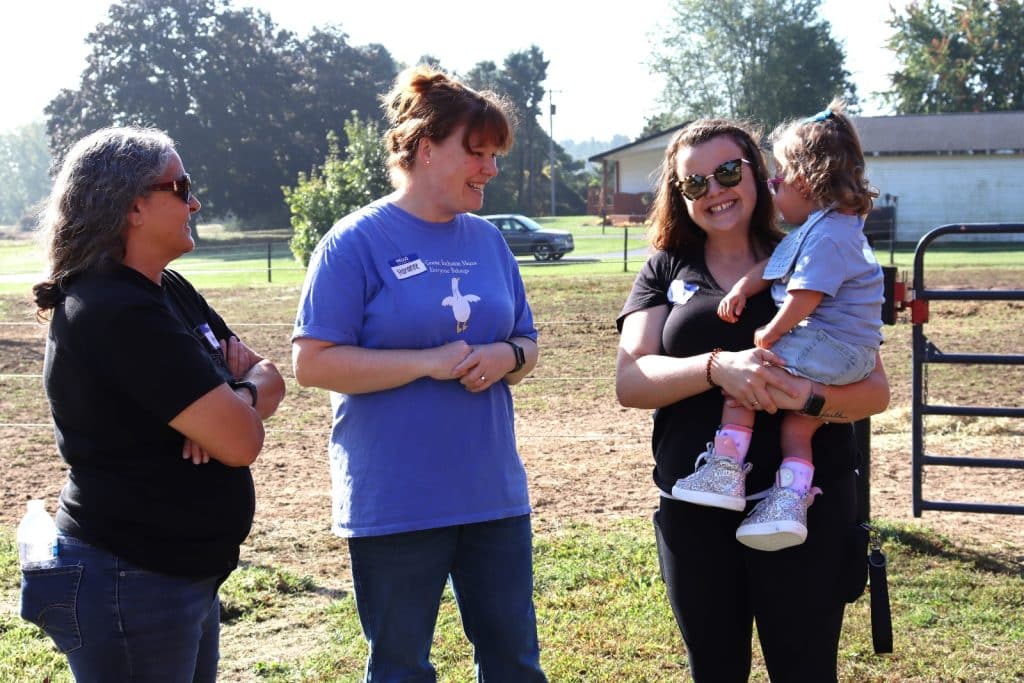
In response, Krueger helped create a playgroup designed for families of children with extensive support needs. These are kids who use feeding tubes or wheelchairs, who communicate differently, or who face complex medical conditions that make typical playgroups difficult to join.
A year later, that playgroup has become a community of understanding and friendship.
“This group is the work I am most proud of,” Krueger says. “It was created to give families of children with extensive support needs a place of connection and acceptance. What began as a response to parents saying, ‘I don’t know anyone else going through this,’ has grown into a community where no one feels alone.”
Finally finding a space
Amanda Strunk remembers meeting Krueger soon after her youngest son, Jacob, was diagnosed with a rare genetic condition that causes developmental delays.
“We’ve not had a child with a disability before,” Strunk says. “I was new to this world and new to Early On, new to having a kid who couldn’t sit up or hold his head or walk. It was hard and scary and difficult. I felt alone.”
Jacob, now 3½, crawls but doesn’t yet walk. He eats through a G-tube, a feeding tube inserted into his abdomen, and works with therapists on speech and motor skills. Even small progress feels like a big win.
“We started outpatient therapy and then heard about Early On,” Strunk says. “Through that, I met Alayna. But I still didn’t know where we fit in. Other playgroups were great, but they didn’t really fit our situation. Jacob had higher medical needs, and there wasn’t a space for us.”
Strunk says she wanted to meet other parents face-to-face. “There were Facebook groups, but I wanted to see people — to meet them, to see their kids, to learn from them,” she says. “When Alayna mentioned starting a playgroup, I said, ‘I’m coming. I’m in.’”
Krueger shared the idea with her Early On colleagues.
“They probably thought I was crazy and adding more stuff to their calendars,” Krueger says, smiling. “But I asked for help because I wanted this to be more than a playdate. My vision was a playgroup where I could connect with families, mainly the moms, and have staff support the kids. That way, parents could relax, talk, and build community.”
Her coworkers quickly agreed. One colleague’s family owned a gymnastics gym in Plainwell and offered it as a meeting space. “We had an area for babies and toddlers with a gate, mats, and equipment where kids could work on motor skills,” Krueger says. “It was perfect.”
The first few months were quiet. “Sometimes it was just Amanda and Jacob and maybe one other family,” Krueger says. “But we kept going. By Christmas, a few more families started coming. Now, a year later, we’ve had about 10 or 11 families participate regularly.”
Those early sessions have grown into something lasting.
“These families have built relationships that go beyond our meetings,” Krueger says. “They text each other, share resources, and plan outings together. Six months ago, they were strangers. Now they’re friends who understand each other’s journeys.”
‘We can travel together’
Krueger’s understanding of the families’ struggles is personal. Her oldest daughter has complex health needs and received a G-tube at age 3.
“There was nobody else in our community that I knew who had a child with a G-tube,” she says. “I remember going online to find people or groups because we didn’t have anything like that. My husband and I had so many conversations: Who do we ask questions to? I could call the doctor, but there was nobody else like us.”
Those memories came back when she began working with families like Strunk’s. “It brought up all those feelings of isolation,” Krueger says. “I never wanted anybody else to feel that way. People already don’t always understand what you’re going through, but to also feel like you don’t belong somewhere — that’s unbearable.”
Krueger wanted to build a place where “every person felt like they had a seat at the table.” Families in the group face a wide range of challenges. One has an infant in hospice care. Another has a toddler with autism who is physically healthy but needs extra support with communication.
“It’s that same isolating ocean,” Krueger says. “We’re just in different boats. But we can still travel together.”
Special connections
What began as a support program has become a network of friendship.
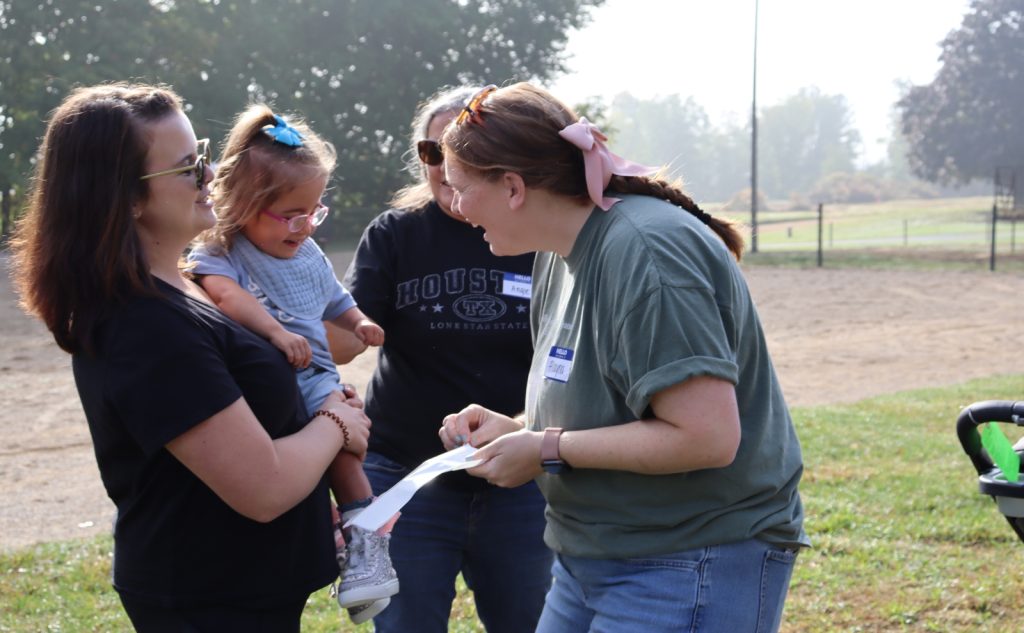
“Building community has been life-changing,” Strunk says. “Having friendships in real life, seeing each other’s kids, cheering them on — it’s been special. There’s something different about another disability mom. It’s a special kind of connection.”
The families now help one another in practical ways. Two mothers whose sons were both diagnosed with autism within a month of each other share advice about therapies and appointments.
“They’re texting each other, asking, ‘What questions should I ask at this appointment?’” Krueger says. “They’re learning from one another in ways professionals can’t always teach.”
Even when staff members step away, the connections continue. “I had to leave early for a meeting once,” Krueger says. “When I came back later, the families had stayed and played together on their own. That’s when I knew this had become something real.”
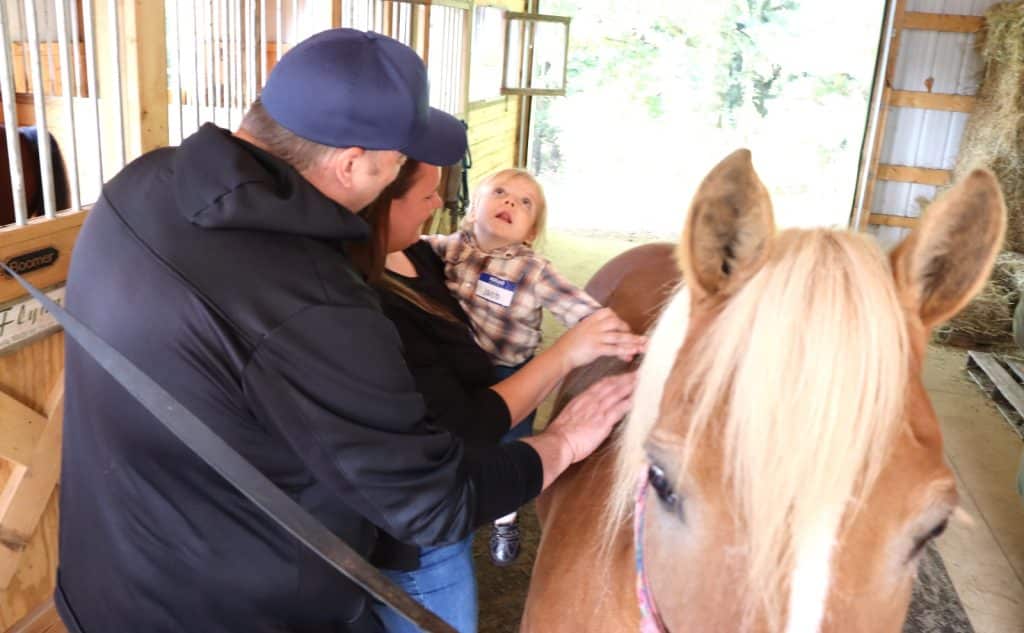
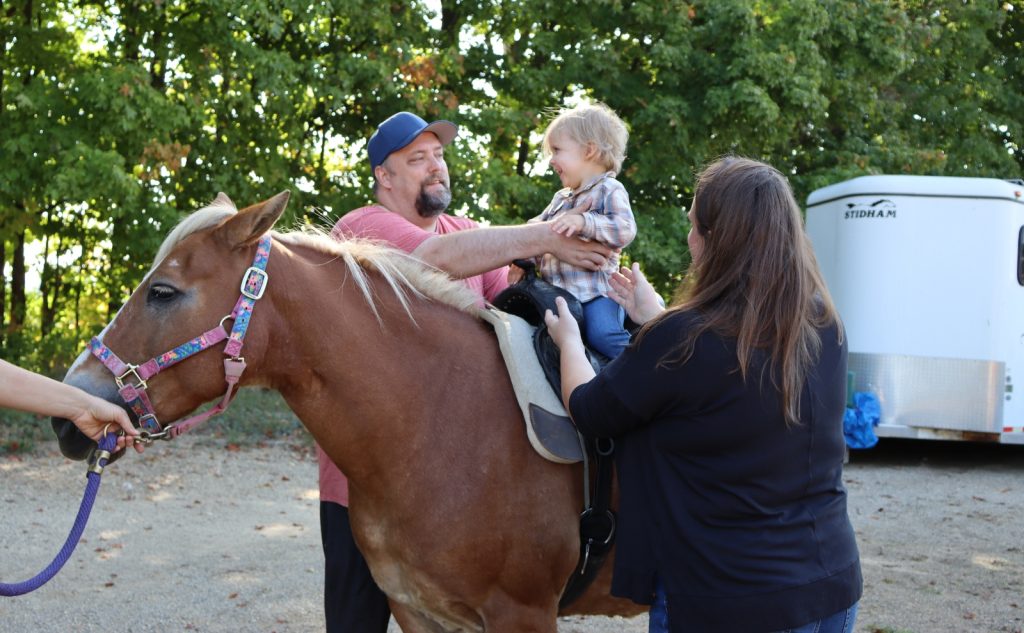
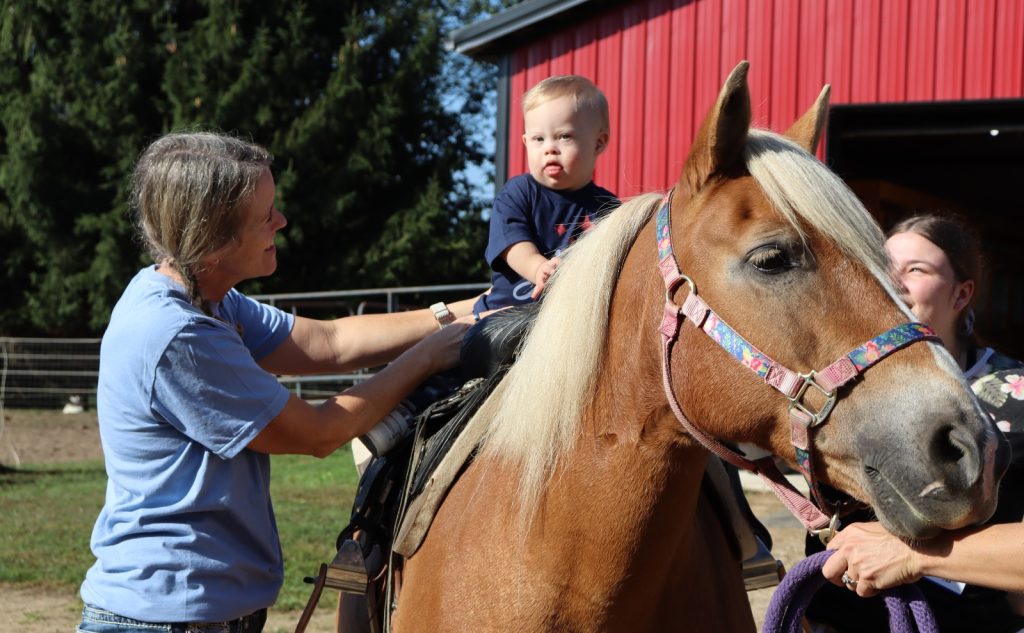
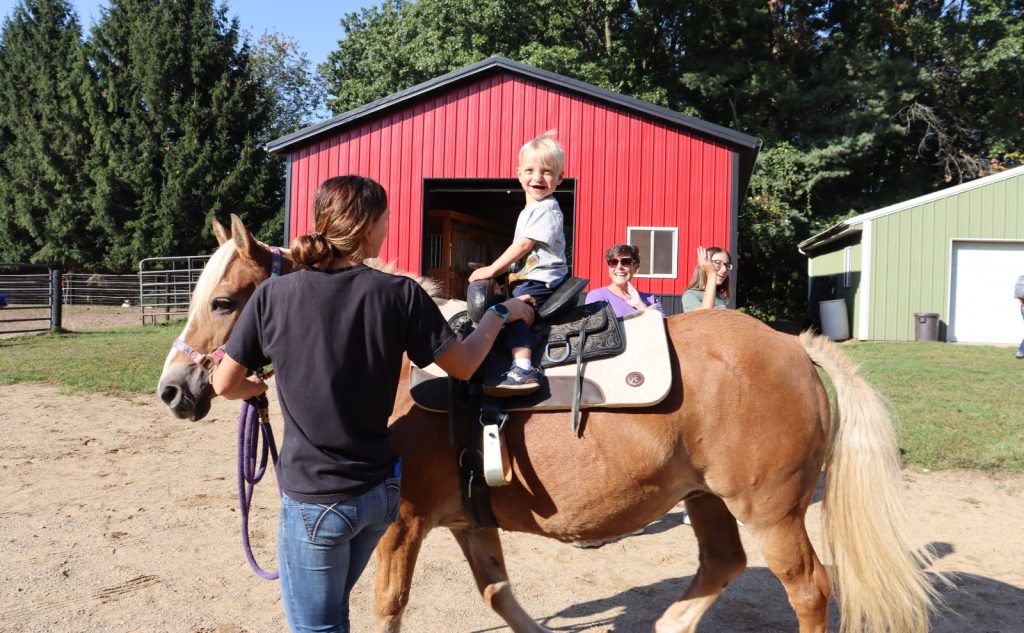
That sense of connection continued at Two Ponds Farm in Allegan, where one of the participating families recently hosted a field trip for the group.
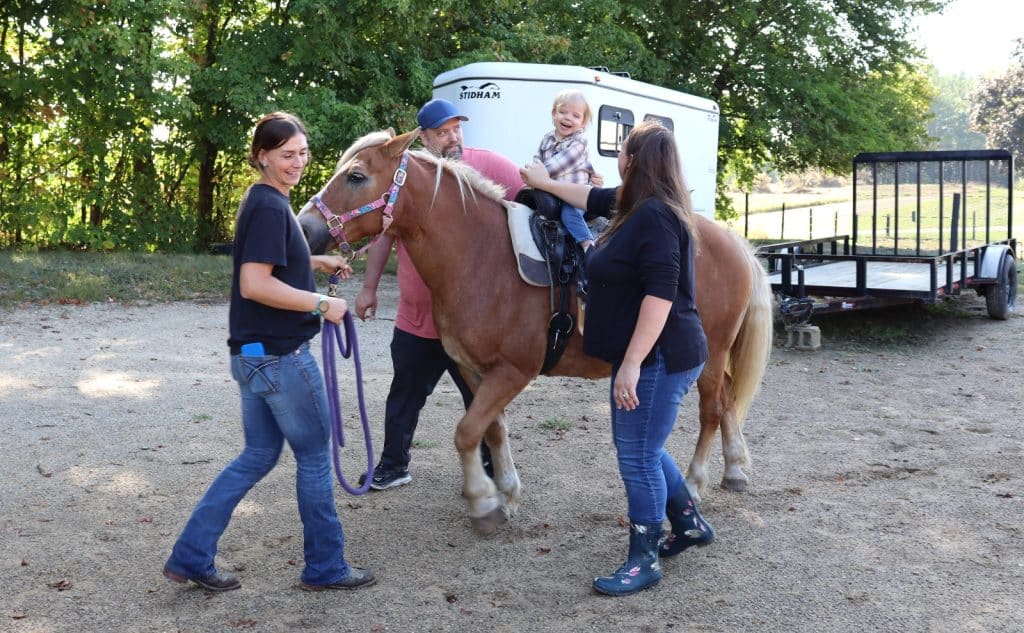
“It’s giving the children a chance to ride a horse, meet animals, and explore,” Krueger said before the trip. “For many, it will be their very first experience of this kind. The best part is that every child, regardless of ability, will be able to participate fully.”
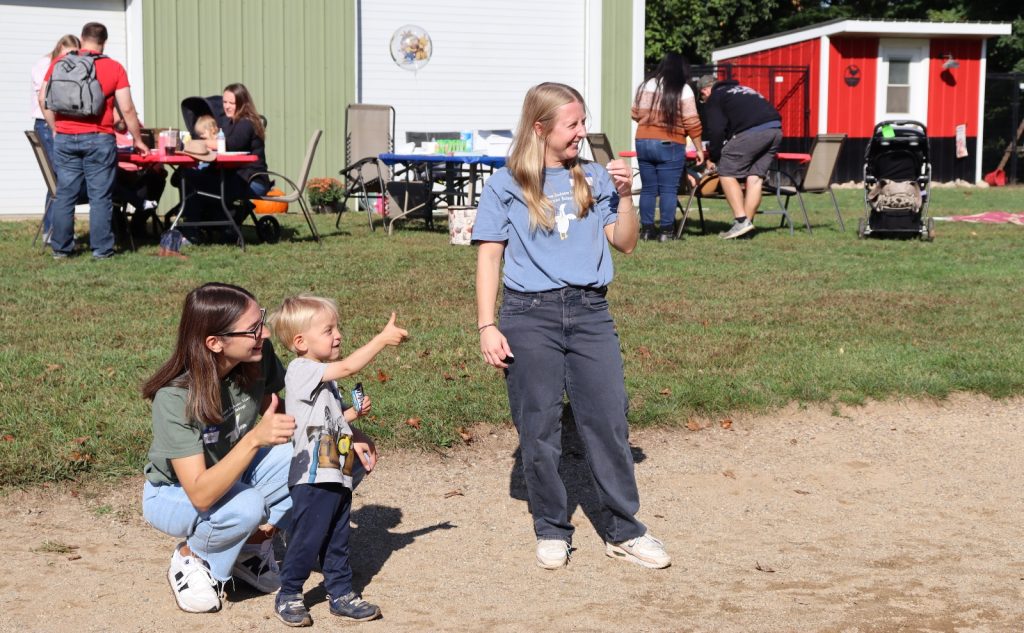
Nine families attended, with 11 children under 3 and 24 adults.
The farm visit brought tears and laughter in equal measure. “Every single one of our kids was able to get on the horse,” Krueger says. “Two kids just sat on the horse while others rode, but everyone participated. One of our babies on hospice was able to ride with extra support, and Jacob enjoyed his first time on a horse. It was such a moving day.”
Strunk remembers it well. “Jacob loved it,” she says. “He likes movement, so when the horse was walking, it was perfect for him. My husband came too — it was special family time. The kids got to ride horses and just be together. Everyone was included.”
Krueger says the day became one of her favorite memories. “Exactly a year after we started, we had more than 30 people there, families, staff, and kids all together,” she says. “It was the best thing I’ve ever been part of.”
Making a broader impact
Krueger hopes the playgroup can serve as an example of inclusion in action.
“It’s allowed us to show what inclusion really means,” she says. “It’s OK for kids who might look or learn differently to belong. And it’s helped us educate the community, people who might not even realize they’re not creating inclusive environments.”
The playgroup is beginning to explore connections with local organizations to host sensory-friendly events and share information about adaptive equipment and family supports.
Krueger says seeing parents take ownership of the group gives her hope.
“We saw a problem– families were isolated – and we built something sustainable and human-centered to solve it,” she says. “The best part is watching families carry it forward. Even if Early On staff weren’t there, it would still exist because they’ve built it together.”
Strunk understands that sentiment.
“I know I can’t do this journey alone,” she says. “But with this community, I don’t have to.”
Photos courtesy of the Allegan Area ESA.
Author

Related Articles
Free AI classes aim to narrow growing digital knowledge gap
Hope alum Tim Haines’ free AI classes support entrepreneurs and business owners, though challenges remain in scaling access and sustaining the model.

Health center trains local residents as dental assistants to fill workforce gaps
HealthLinc, a federally qualified health center covers training costs while preparing local residents for dental assistant jobs, strengthening workforce pipelines and expanding access to care.
Students lead Anne Frank exhibit promoting empathy and community dialogue
Student docents guide visitors through Anne Frank exhibit and film event focused on history, human connection, and community understanding.