New Lakeshore Advantage role targets region’s workforce housing shortage
Community Development Director Chris Marco will help communities and developers expand workforce housing across Ottawa and Allegan counties.
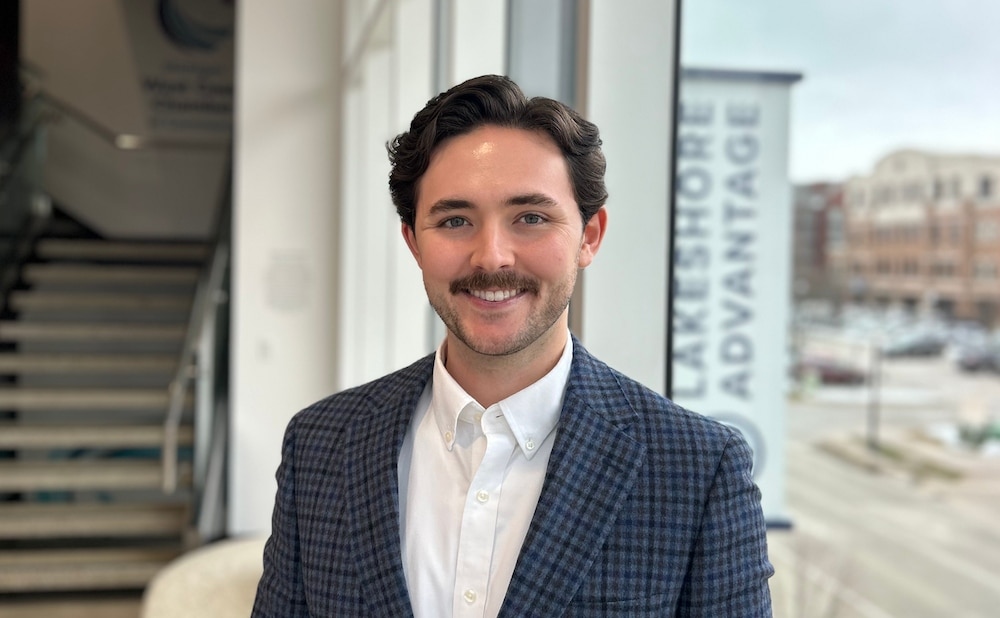
For Chris Marco, newly hired community development director at Lakeshore Advantage, the region’s housing shortage is more than just a professional challenge – it’s an issue that touches his life.
“My friends, my colleagues, and even my fiancée and I are looking for housing,” Marco says. “I feel very aware of the needs of the community.
“I’m a Hudsonville native, born and raised in West Michigan, so this work feels very personal to me.”
Marco is the Holland-based economic development organization’s first community development director, helping communities across Ottawa and Allegan counties develop workforce housing so nurses, teachers, and other young professionals can afford to live where they work.
The position is designed to help communities, developers, and employers collaborate on housing solutions and move projects from concept to construction.
Marco began the job in February.
“This is a really exciting opportunity for Lakeshore Advantage to enter the workforce housing space that employers have said is stifling regional economic growth,” Marco says.
Barrier to growth
The new role comes as the region faces a significant housing shortage that could threaten the area’s economic vitality.
Housing-needs assessments conducted by Bowen National Research estimate Ottawa and Allegan counties together face a shortage of roughly 22,700 housing units. Local employers increasingly identify housing availability and affordability as barriers to attracting and keeping workers.
A 2023 study on emerging workers commissioned by Lakeshore Advantage found that housing is a key factor influencing whether young professionals choose to move to or remain in the region.
“As we’ve listened to our primary employers and studied the data, the message is clear: housing is economic development,” says Jennifer Owens, president of Lakeshore Advantage.
“If we want to remain a business and talent magnet, people who power our companies need to find a place to call home here,” Owens says. “This is a complex challenge that requires coordination, creativity, and trusted partnerships. That’s the role we’re stepping into.”
The organization’s new effort centers on workforce housing, typically defined as housing affordable to households earning 60% to 120% of the area median income.
“Workforce housing focuses on the ‘missing middle,’ people who don’t qualify for low-income assistance but also can’t afford a half-million-dollar home,” Marco says. “We’re talking about nurses, teachers, firefighters, and other essential workers.”
Many young professionals leave the region after graduating from college, Marco says, often citing housing costs and availability as factors.
“I had friends from college who moved to Chicago, Austin, or New York right after graduation,” Marco says. “Housing availability and affordability were identified as major reasons young professionals either leave the region or choose not to move here.”
Finding funding, strategic partnerships
Part of Marco’s work involves helping communities and developers identify funding tools and strategies that can make housing projects financially viable.
“My role will support local leaders and developers in identifying and understanding the tools available, from state and federal financing programs to innovative local strategies, and bring the right partners to the table,” he says. “When resources align and projects move forward thoughtfully, communities and the regional economy benefit.”
Lakeshore Advantage plans to act as a regional connector across Ottawa and Allegan counties, helping housing stakeholders collaborate and advance development projects.
Marco says building relationships among local governments, developers, and nonprofits will be essential.
“We want to build relationships with local government partners and collaborate with nonprofits, developers, and organizations that have already been working in this space for years,” Marco says.
Marco’s work includes helping municipalities identify development opportunities, assisting developers with grant applications and financing tools, and sharing best practices from housing initiatives across the state.
“I see myself as an extended member of the staff of cities and development firms, helping connect people, identify resources, and move projects forward,” Marco says.
The goal is to accelerate housing development.
“We want to start moving dirt on projects and making things happen,” he says.
Balancing priorities
Marco, 26, began his career with the city of Grand Rapids, working in its community development department. There, he helped manage federal Community Development Block Grant programs, supported housing initiatives, and conducted public policy research.
The work included collaborating with organizations serving the city’s unhoused population.
He later joined the Michigan Economic Development Corporation, where he managed community development projects across the state and worked with housing finance programs and development incentives.
That experience helps him understand both the opportunities and the complexities involved in housing development.
“Developers need projects to be financially viable, but they also need to meet the needs of the community,” Marco says. “My goal is to help balance those priorities.
“Housing has a generational impact. When you drive by a house, you might think it’s just a house, but inside there’s a life and a family.”
Lakeshore Advantage is also working with Housing Next, a regional partnership that provides policy leadership and technical expertise on housing development across 13 counties in West Michigan.
Marco recently met with Ryan Kilpatrick, the founder of Housing Next and Flywheel Community Development Services, to discuss strategies. Housing Next has supported housing initiatives in the Lakeshore region since 2017.
“We’ll be working hand in hand to advocate for best practices and strategies that will be effective,” Marco says.
Author

Related Articles

United in Recovery: Grassroots efforts and rapid relief aid rural Michigan’s hardest-hit regions
Amidst the wreckage, recovery has begun, spearheaded by nearly 50 Red Cross disaster specialists and a massive grassroots initiative to restore power and provide refuge.

Summit focuses on solutions to Allegan County’s housing shortage
The Allegan County Housing Summit will bring leaders together on May 8 to explore solutions, tools, and strategies to address a 6,200-unit housing shortage.
Collaboration helps unhoused residents with disabilities navigate housing crisis
Local agencies, including Disability Network Northern Michigan, collaborate to help unhoused residents with disabilities find housing in Traverse City’s tight market.