Polio survivor drives advocacy and access across West Michigan
Muskegon Heights resident Larry Latin uses lived experience to improve accessibility, challenge attitudes, and promote inclusion through advocacy.
Larry Latin has spent much of his life working to make West Michigan more accessible for people with disabilities. He first worked as a disability advocate, helping put the Americans with Disabilities Act into action. Today, he serves as a board member for the Disability Network West Michigan.
“A lot of times people see a wheelchair before they see a person,” says Latin, 74, who lives in Muskegon Heights. “What I want is for people to see the whole person.”
Latin contracted polio as a toddler during the early 1950s, just months before a vaccine became widely available. He says he was hospitalized in Muskegon and placed in an iron lung, sharing a ward with 17 other children.
“Me and one other girl were the only ones who survived,” he says.
The disease limited the use of his left arm and leg and affected much of his right side. He says he does not remember what it feels like to walk without wearing braces.
“I don’t remember being able to walk normally,” he says. “This is the only way I know.”
Mother’s unflagging advocacy
Children with disabilities, he says, were often separated in school and viewed as incapable of academic or professional success.
“There were no positive expectations,” Latin says. “People didn’t think we had anything to offer.”
He says his mother was his biggest advocate. Drawing from her experience caring for a sister who lost a leg as a child and was raised with few expectations, she resolved to raise her son differently.
“Whatever I could do for myself, she let me do,” Latin says. “Anything I could learn to do, she made sure I learned.”
Latin says he struggled emotionally for many years, particularly during childhood and adolescence, with anger over his disability and questions about faith.
“I was mad at God,” he says. “I was a baby when this happened. I hadn’t done anything wrong.”
He remembers coming home to find his mother crying in the kitchen. When he asked why, she told him she believed she had failed him.
“She said she prayed for me to live,” Latin says. “She didn’t pray for me to be healed.”
For many years, he says, he resented the faith that surrounded him growing up because he questioned why his life had been altered while others were spared.
“I didn’t want to go to church,” he says. “I didn’t see the point.”
At a young age, he says, daily life already presented obstacles.
“I could see how hard things were going to be,” he says.
That internal struggle lasted years. What changed, he says, was his outlook, influenced largely by his mother’s refusal to let disability become an excuse to disengage.
“She wouldn’t let me feel sorry for myself,” Latin says. “She just wouldn’t allow it.”
Isolated in school
School made him feel more separated from other students. In elementary school, Latin was placed in one classroom with other students who had disabilities. He had the same teacher from first through sixth grade.
He says the teacher worked hard and helped him learn to read and do well in school. At the same time, he says being separated from other students made him feel isolated.
“You knew you weren’t like the other kids,” he says.
That difference became more pronounced in ninth grade. A school counselor told Latin he was “not college material” and placed him in general-track courses without consulting his family.
When Latin brought the schedule home, his mother rejected it.
“She said, ‘Where’s the algebra?’” he says.
At her insistence, Latin returned to the counselor’s office and refused to leave until he was put into college preparatory classes.
“She wasn’t an educator,” Latin says. “But she knew what her son was capable of.”
Latin eventually earned a bachelor’s degree in criminal justice from Ferris State University after an interrupted early college experience. He later moved to Arizona, where exposure to disability services work helped clarify his career path. He earned a master’s degree in social work from Arizona State University.
Plans to remain in Arizona changed when family responsibilities called him home. His father died while Latin was away, and his mother became ill shortly after his return.
“I wasn’t there when my dad passed,” he says. “I wasn’t going to do that again.”
Surprise opportunity
Back in Michigan, Latin noticed an unusual job posting: an organization seeking applicants with disabilities who also held advanced degrees.
“I thought it had to be a misprint,” he says. “It wasn’t.”
Latin was hired by Disability Network Lakeshore, based in Holland, in the 1980s. The organization is one of Michigan’s federally recognized Centers for Independent Living and, at the time, served Ottawa, Allegan, and Muskegon counties.
Working as an advocacy specialist, Latin assisted individuals with disabilities while addressing barriers related to housing, employment, and public access across the three-county region.
He says the role expanded when the Americans with Disabilities Act took effect in 1990. He trained as an accessibility advocate and helped lead access teams that evaluated public buildings throughout the service area.
“When people in charge of facilities saw me coming, they frowned,” he says. “They figured I was going to cost them money.”
Latin says the work required persistence and diplomacy.
“My job wasn’t to shame anybody,” he says. “It was to show them what wasn’t working and how to fix it.”
Many of the accessibility improvements implemented during that period remain visible today, particularly in Muskegon County buildings and public spaces.
“You can knock down a wall easier than you can change an attitude,” he says.
That belief guides Latin’s current work as a new board member of Disability Network West Michigan.
“The real barrier is worldview,” he says. “Once that changes, everything else follows.”
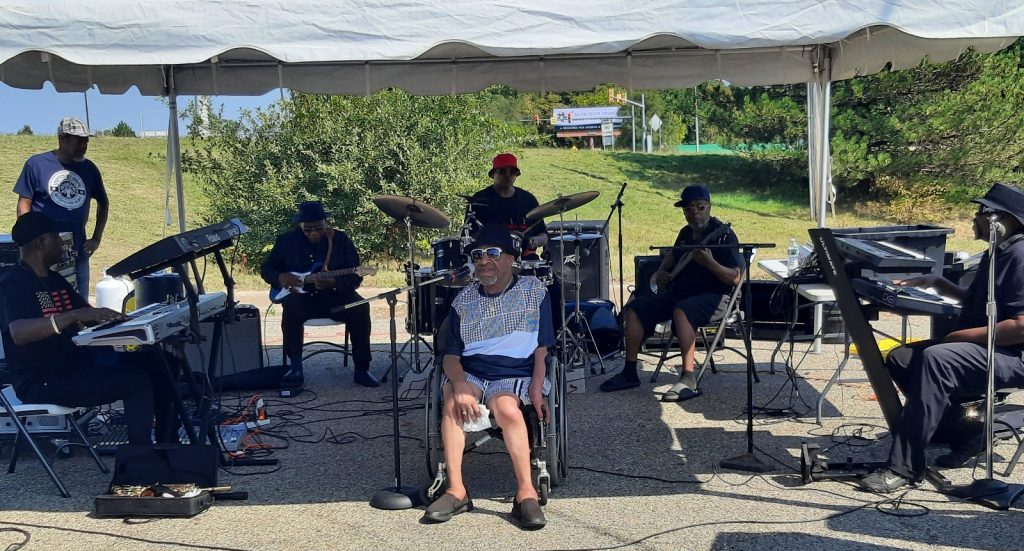
Latin is also well known for his musical talent. He’s a lifelong singer and songwriter. He performs with his band, Dark Knights of Souls. He credits music with helping him connect with peers as a teenager after transferring to a downtown school away from his neighborhood friends.
“When I got on stage, people saw something else first,” he says.
Music continues to serve as a form of advocacy, offering visibility without explanation.
“I don’t have to argue,” he says. “I just sing.”
The multi-regional Disability Inclusion series is made possible through a partnership with Centers for Independent Living organizations across West Michigan.
Author

Related Articles
Ticket to Work helps people with disabilities return to work safely
The program offers guidance and support so people with disabilities can work without losing benefits, addressing fears, complexity, and financial instability.
How mentorship helps one man build stability despite setbacks
A long-term mentoring relationship shows how accountability, honesty, and persistence can support progress, even as challenges and setbacks continue along the way.
New toolkit helps Michigan communities design homes for everyone
A new statewide toolkit guides planners and developers to build accessible housing that supports aging residents and people with disabilities.