Nonprofits unite to build Holland’s largest affordable housing community
Three nonprofits collaborate on an 18-acre project creating 120 mixed-income homes, expanding affordability, stability, and opportunity in Holland.
Steve Grose can’t hide his excitement as he talks about what could become one of the largest affordable housing projects Holland has seen in decades.
“This is by far the biggest project for us,” says Grose, executive director of Jubilee Ministries. “In terms of for-sale housing right here in Holland, it’s probably been a long time since something this big has been built, and certainly never focusing on affordability.”
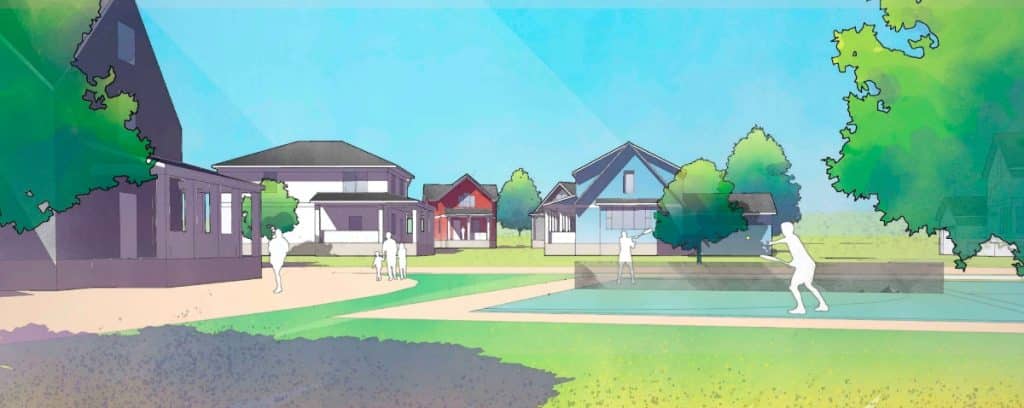
The project he’s referring to is an ambitious collaboration among Lakeshore Habitat for Humanity, Jubilee Ministries, and Gateway Mission, three nonprofits that share a belief that stable housing is key to individual and community health. Together, they’re planning a new 18-acre neighborhood that will blend affordability, stability, and opportunity for residents across a wide range of incomes.
Productive partners
For Grose, this project is the culmination of years of partnership. Jubilee and Lakeshore Habitat have collaborated for five years, developing mixed-income neighborhoods that combine affordable homeownership with long-term stability. Adding Gateway Mission to the partnership creates an opportunity to pool expertise, volunteers, and resources to scale housing options more efficiently.
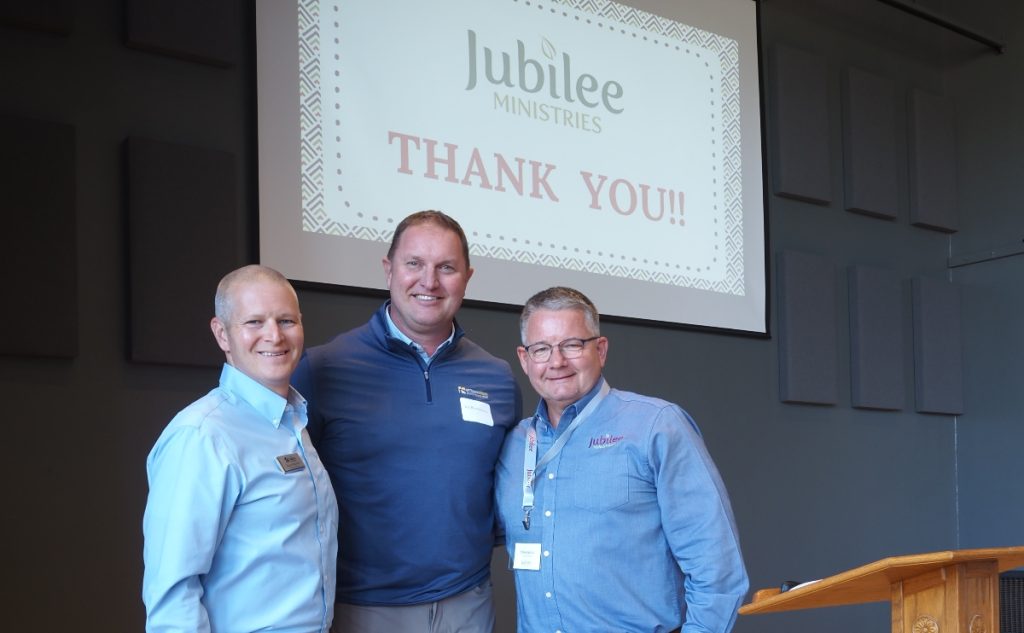
“We’ve created three mixed-income developments so far, totaling 63 homes,” Grose says. “We’ve been talking to Gateway for probably three years about wanting to do something with them, and then there was some contact with a donor who had some property. That donor liked the mission of all three organizations, and after talking with them for a while, we’re in the process of having that donated.”
This anonymous donation will allow the nonprofits to move forward with what Grose calls a “project of unprecedented scale and impact.”
“This donor understands the need well enough to work with us to donate the property,” Grose says. “They love the collaboration that’s happening between the organizations.”
A balanced community
At least 120 homes are planned for the site. The development will include transitional housing units managed by Gateway Mission for individuals moving out of homelessness, starter homes built by Jubilee and Habitat for Humanity for working families earning between 30% and 120% of the area median income, and a small portion of market-rate homes to foster a balanced, mixed-income community.
“It’s truly a mixed-income community,” Grose says. “Basically, from people transitioning out of homelessness all the way to market rate.”
For the working families Habitat and Jubilee typically serve, affordability is defined by area median income (AMI). “Habitat works with folks from 30 to 80% of the AMI,” Grose explains. “Jubilee starts at 80 and goes to 120.”
That range includes many of Holland’s essential workers, such as teachers, first responders, health care employees, and factory workers who have been squeezed out of the current housing market. “The typical buyer is working in health care or as a first responder or teacher,” Grose says. “They’re the people that traditionally have jobs where you should be able to afford housing, but if you look in our greater community, there’s just nothing out there under $250,000.”
Like many regions across Michigan, Holland faces a severe shortage of affordable housing. Rising home prices, limited land availability, and zoning restrictions have all contributed to a gap that affects workers and families across income levels.
“The need is out there,” Grose says. “People are just screaming for help — something that’s more affordable. Jubilee is doing a project right now where we’re going to have six townhomes, all under $200,000, and even before we finished framing them, they were all spoken for.
“The hard thing right now is finding places to build,” Grose says. “So much of the land right around here is either developed or not zoned for the type of housing you do. There’s just no land zoned for the type of housing that critical workers can afford.”
Boost to school district
The benefits of more affordable housing go beyond homeownership. They extend into the classrooms of Holland Public Schools. For Grose, that connection is deeply personal. Before leading Jubilee Ministries, he served on the Holland school board for 16 years.
“Their enrollment is up for the second straight year, and that’s encouraging,” Grose says. “When you think about it, any new housing that’s been built within the Holland Public Schools district over the past 20 years has been minimal.”
That’s why Grose is proud that Jubilee and Habitat’s earlier developments are helping the district grow. “Our first development had only 10 houses, and 18 kids went to Holland Public Schools,” he says. “The next one we’re partway through has 42 homes. So if that ratio continues, the district is going to see steady enrollment growth.”
For school districts like Holland, where enrollment directly affects funding, affordable housing can make the difference between contraction and stability. “That’s how school districts live and die,” Grose says. “It’s how they fund teachers and programs. Creating housing that allows families to live in the city is critical.”
It’s a full-circle moment for Grose, who first ran for the school board decades ago because he wanted to help solve local challenges, not just talk about them.
“I figured I could sit and complain, or I could try and be part of the solution,” he recalls. “Now, it’s the same motivation, only this time, it’s about creating homes and opportunities for the next generation of families.”
After the property transfer is finalized, the three nonprofits will begin work with city planners and local officials, and a series of public meetings will be held before the project can get official approval.
“Once it’s approved, then we have to put in roads and sewer and water,” Grose said. So we’re probably a couple of years away from actually building homes. But once that starts happening, it’s going to go very quickly.”
The homes themselves will be modestly sized to keep costs low. “We’re really focusing on starter homes,” Grose says, smaller homes with one to three bedrooms.
Understanding the need
Grose says this project reflects a shift in how Holland approaches its housing challenges. As awareness grows, so does empathy for those struggling to find homes near where they work.
“From a community understanding standpoint, it’s starting to hit close to home for people,” Grose says. “They might have kids who have really good jobs but can’t afford housing. Employers are seeing it too — from a recruitment and retention standpoint — that people they’re hiring aren’t putting down roots because they can’t afford it.”
If this development succeeds, Grose believes it could become a model for other communities across West Michigan.
“In terms of scale, in terms of impact, in terms of increasing the income ranges, this is huge,” he says. “To be able to add Gateway Mission and market-rate builders. All the way from folks ready for transitional housing to market rate. I don’t know of another development anywhere like it.”
For Grose, who has spent his career working at the intersection of faith, housing, and community, this project represents both the future and the fulfillment of a long-held vision.
“This collaboration shows that by working together, we can do far more than we ever could on our own,” he says.
“The need for housing is urgent at every level. This partnership gives us a way to meet those needs together with compassion, creativity, and hope.”
Author

Related Articles

United in Recovery: Grassroots efforts and rapid relief aid rural Michigan’s hardest-hit regions
Amidst the wreckage, recovery has begun, spearheaded by nearly 50 Red Cross disaster specialists and a massive grassroots initiative to restore power and provide refuge.
Summit focuses on solutions to Allegan County’s housing shortage
The Allegan County Housing Summit will bring leaders together on May 8 to explore solutions, tools, and strategies to address a 6,200-unit housing shortage.
Collaboration helps unhoused residents with disabilities navigate housing crisis
Local agencies, including Disability Network Northern Michigan, collaborate to help unhoused residents with disabilities find housing in Traverse City’s tight market.